Evidence Wins Cases
Michigan Truck Accident Evidence The 72-Hour Truck Crash Protocol
Developed by Michigan trial lawyer and author Joseph Dedvukaj
Author of 164,000 Pounds
A loaded truck crash is not a bigger car crash. A carrier may put an investigator on the scene quickly, and the records that prove what happened—engine data, electronic logs, telematics, dashcam—are held by different custodians on retention schedules that vary by equipment, policy and regulation. This is what Joseph Dedvukaj does in the first seventy-two hours, and why each step matters.
The first 72 hours are an investigative framework, not a legal deadline. General information about evidence categories and timing. Not legal advice, and not a description of strategy in any particular case.
- 72
- An Early Preservation Framework
- 6
- Truck Results on This Page
- 30+
- Years in Michigan Courts
The Protocol
What happens in the first seventy-two hours
Each window below names the records pursued and the reason the clock matters. It is a description of categories and urgency, not of strategy in anyone’s case.
-
Hour 0–6
Identify and Freeze
Before anything can be preserved, the right parties have to be named — and told, in writing, not to destroy anything.
- Carrier and vehicle identification
- The tractor, the trailer and the driver frequently belong to three different companies. Naming the wrong one wastes the only window that matters.
- Spoliation preservation notice
- A written demand that the truck, its electronics and the carrier’s records be preserved. It puts the recipient on notice; it is not a court order, and the follow-up is what makes it work.
- Crash scene and video
- Gouge marks, debris fields and skid evidence are often cleared before anyone photographs them. Nearby business and traffic cameras have to be found and their owners asked — retention is set by each system, not by a common rule.
-
Hour 6–24
Target the Electronic Record
Commercial trucks generate data that a passenger car does not. How long each record survives depends on the equipment, the provider and the rule that applies.
- ECM / EDR download
- A heavy truck may carry an engine control module, a brake controller and a dedicated event recorder, each storing different parameters. The specific hardware has to be identified before the vehicle is driven, repaired or scrapped.
- ELD and hours-of-service logs
- Identify the driver’s duty records, the applicable ELD requirements or exceptions, the required supporting documents and the required backup — retained six months from the carrier’s receipt, not from the crash. Fatigue cases are won or lost here.
- Telematics and dashcam
- Usually cloud-hosted. Some fleet messages are supporting documents the six-month rule reaches; other telematics data is governed only by the provider’s arrangement and the carrier’s preservation duty.
- Post-accident drug and alcohol testing
- Required after a fatality, and after injury or tow-away crashes where the driver is cited (49 C.F.R. § 382.303). Confirm whether testing was done, when, and by whom.
- Driver qualification file and dispatch
- Licensing, medical certification, prior violations, training, and the dispatch messages that show what the driver was told and when.
-
Hour 24–48
Map the Money and the Relationships
One truck can involve a driver, a motor carrier, a broker, a shipper, a lessor and a maintenance contractor — each with its own insurance.
- Ownership, broker and shipper chain
- Who owned the tractor, who leased it, who booked the load and who loaded it. Each relationship can create a separate route to liability.
- Maintenance and inspection history
- Brake, tyre and annual inspection records, plus repair orders — evidence that a defect was known before the crash.
- Insurance towers
- Federal minimums are frequently far below the cost of a catastrophic injury. Excess and umbrella layers have to be found, not assumed.
- Witnesses and surveillance
- Independent witnesses become unreachable and memories fade. Surveillance from surrounding properties is pursued while it still exists.
-
Hour 48–72
Set the Inspection and Name the Gaps
By the end of the third day the case has a shape: what is secured, what is contested, and what is already gone.
- Expert evaluation
- Accident reconstruction, trucking-industry practice, and treating-physician input evaluated against what the evidence will actually support.
- Vehicle inspection strategy
- A joint physical inspection of the tractor and trailer arranged before repair, salvage or sale puts the vehicle out of reach.
- Federal and state regulatory issues
- Where the Federal Motor Carrier Safety Regulations and Michigan’s no-fault act each apply — two different bodies of law running at once.
- Evidence gaps identified
- An honest list of what could not be obtained, and why. Knowing the hole early is worth more than discovering it at deposition.
Why the Clock
What can disappear in 72 hours — and what federal law makes carriers keep
Evidence changes before any legal retention period runs out. A camera records over itself. A truck gets moved, repaired or sold for salvage. Debris is swept off the roadway before anyone photographs where it landed. The first 72 hours are when the most fragile evidence is most likely to be lost.
That is why the Protocol focuses on those hours. It is a framework for early investigation — not a deadline, and not a reason to give up if more time has passed.
The six-month rule — what it does and does not cover
Federal law requires a motor carrier to keep the driver’s records of duty status and the supporting documents behind them for at least six months from the date the carrier receives them (49 C.F.R. § 395.8(k)(1)). The ELD data must also be backed up on a separate device for six months (§ 395.22(i)(1)).
Two things follow. First, the clock runs from receipt, not from the crash — logs from the week before a collision were already aging when it happened. Second, the rule covers duty records and their supporting documents. It does not require anyone to keep dashcam video, engine data or a neighbour’s security footage for six months. Those have to be run down separately.
| Evidence | What matters right now |
|---|---|
| Roadway and vehicle condition | Photograph and measure before cleanup, movement, repair or disposal changes it. |
| Dashcam footage | Identify the camera system, its recording settings and any saved event clips. Retention varies by model and configuration. |
| Nearby surveillance | Find the owner. Ask whether a recording exists, whether it covers the time, and how to preserve it. Never assume a camera captured the crash. |
| ECM and event-recorder data | Identify the specific modules on the truck and get a qualified examiner involved before the vehicle is driven, repaired or scrapped. |
| ELD and fleet records | Preserve the originals, edits, exports and the required backup. Separate the duty records the rule protects from the other data the same platform holds. |
| Post-accident drug and alcohol tests | Required in specified crashes. Confirm whether testing was done, when, and by whom (49 C.F.R. § 382.303). |
Some fleet messages are supporting documents. The rule counts qualifying electronic mobile communications sent through a fleet-management system (§ 395.11(c)). What a record shows controls whether the rule reaches it — not whether the carrier files it under “telematics”.
A retention minimum is not permission to destroy. Once litigation is reasonably foreseeable, a party that controls relevant evidence must keep it — before suit is filed and regardless of its ordinary retention schedule (Brenner v. Kolk, 226 Mich. App. 149 (1997)). A preservation letter puts the carrier on that notice. It does not, by itself, secure anything.
The working questions are simple: What exists? Who controls it? What has to happen now to keep it?
Record-by-record detail: Truck Evidence Retention Deadlines in Michigan
The Method, Applied
Michigan truck cases Joe has resolved
Every one began the same way: identify the carrier, preserve the record, prove what the truck actually did.
-
$3.85M
Commercial truck accident
$3,850,000 Settlement for Trucker Injured by Fatigued Co-Driver
-
$1.85M
$1.85 Million Recovered to Date for Michigan Truck Driver After Hit-and-Run Semi-Truck Crash
-
$1.35M
Fire Truck Accident
$1,350,000 Settlement: Overcoming Governmental Immunity in Fire Truck Collision
-
$975K
Truck accident
$975,000 Settlement: Holding Trucking Company Accountable for Red Light Collision in Sterling Heights
-
$975K
Trucking accident
$975,000 Settlement: Using Expert Reconstruction to Win a Disputed Truck Accident Case
-
$900K
Trucking accident
$900,000 Settlement: Victim of Fatigued Truck Driver Gets Justice
Prior results do not guarantee a similar outcome. Every case is different.
Attorney Access
You Hire Joe.
You Get Joe.
A truck crash case is decided by what is preserved in the first days and by who is willing to try it if the carrier will not pay. Both of those are the same person here.

Joseph Dedvukaj
Michigan Car & Truck Accident Trial Lawyer
- Joe evaluates the case
- Not an intake screener working from a script. The lawyer who would try the case is the one who decides whether to take it.
- Joe is reachable
- Direct access to the attorney handling your matter, including evenings and weekends. Serious truck cases do not keep office hours.
- Joe tries cases
- Practising in Michigan since 1994. Carriers and their insurers price a claim differently when the lawyer across the table has taken cases to verdict.
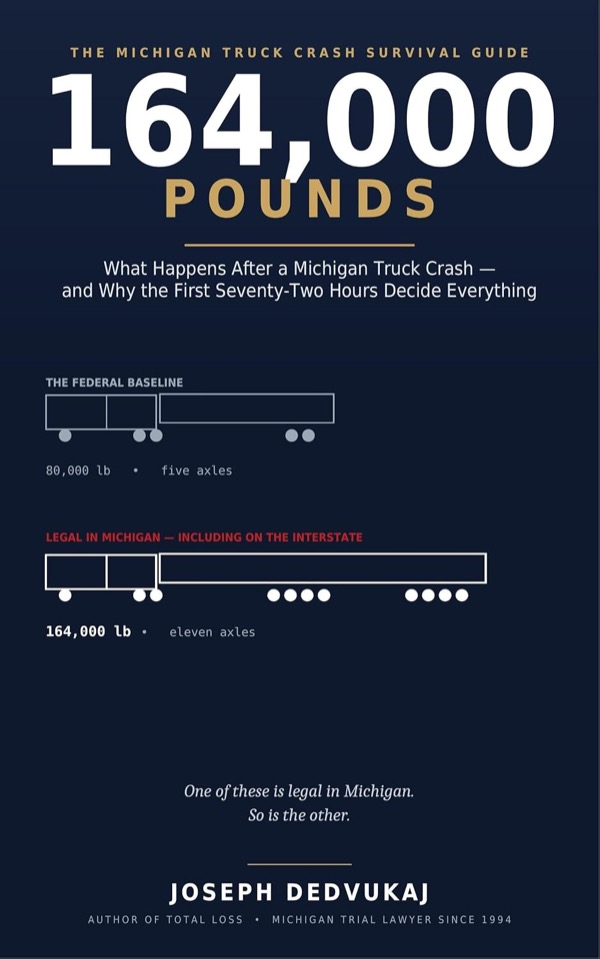
The Book Behind the Protocol
164,000 Pounds
What Happens After a Michigan Truck Crash — and Why the First Seventy-Two Hours Decide Everything
The carrier's investigator is often at the scene before the injured family has been told which hospital to drive to.
Talk to Joe
No Fees Unless We Win
If you or someone in your family has been hurt by a commercial truck in Michigan, the evidence is already on the clock. Call Joe, day or night, for a free consultation.
Free consultation • Confidential • No obligation