The job is to identify each source, find out who controls it, and preserve it while it still exists. This article sets out what the rules actually require and where they stop.
Federal retention rules by record type
These are the requirements that matter most after a crash. They are not a complete schedule, and each applies only to carriers, drivers and operations within its scope — intrastate operations require a separate applicability check. Litigation can extend every period listed.
| Record | Federal retention requirement | Authority |
|---|---|---|
| Driver records of duty status and supporting documents | Six months from the carrier’s receipt — not six months from the crash. | 49 C.F.R. § 395.8(k)(1) |
| ELD backup | Six months, on a device separate from the original storage. | 49 C.F.R. § 395.22(i)(1) |
| Post-accident drug and alcohol test records | Five years for alcohol results of 0.02 or greater, verified positive drug tests and refusals; one year for negative results. Testing is required after a fatality, and after injury or tow-away crashes where the driver is cited. | 49 C.F.R. § 382.303; § 382.401 |
| Vehicle inspection, repair and maintenance records | One year where the vehicle is housed or maintained; six months after the vehicle leaves the carrier’s control. Applies to vehicles controlled for 30 consecutive days or more. | 49 C.F.R. § 396.3(b)–(c) |
| Driver vehicle inspection reports (DVIRs) | Three months from the date the written report is prepared. A report is required only when a defect is found or reported. | 49 C.F.R. § 396.11(a)(4) |
| Periodic (annual) inspection reports | Fourteen months from the report date. | 49 C.F.R. § 396.21(b) |
| Driver qualification file | Throughout employment and three years after; certain items may be removed three years after execution. | 49 C.F.R. § 391.51(c)–(d) |
| Accident register and required accident reports | Three years after the date of each qualifying accident. This is a register requirement, not a three-year rule for video or electronic data. | 49 C.F.R. § 390.15(b) |
Pre-crash records were already aging when the collision happened. The investigation has to identify relevant history immediately, not count forward from the crash date as if every clock started that day.
ELD records: get the logs and everything behind them
The electronic logging device records hours of service. Its logs show what the driver reported — not necessarily what the driver did. They must be checked against dispatch records, fuel receipts, bills of lading, GPS history and phone records.
A preservation demand for ELD data should reach the original records, every edit and annotation, driver and vehicle assignments, unassigned driving time, all exports, and the separate backup copy required by § 395.22(i). It should cover a justified period before the crash, not just the crash date. Asking only for what appears on the in-cab display misses the rest. FMCSA’s own guidance on ELD retention confirms the backup obligation.
Not every driver must use an ELD. The exceptions in § 395.8(a) have to be checked — but an exempt driver still generates paper logs, timecards or other records, and those are the target instead.
Supporting documents: why some telematics data is inside the six-month rule
Section 395.11 lists the categories a carrier must keep to verify duty status: bills of lading and dispatch records, expense receipts, electronic mobile communications sent through the fleet-management system, and payroll or settlement records. It also specifies the content each document must contain and how many must be kept per day (§ 395.11(c)–(d); FMCSA guidance).
The consequence is a split inside the same platform. A dispatcher’s message telling the driver to push through to Detroit is a required supporting document with a six-month floor. The GPS breadcrumb trail from the same system may not be. The demand must name the specific records and their content, and the follow-up must confirm the provider’s actual storage arrangement.
Black-box and ECM data: identify the hardware before you describe the evidence
“Black box” is a label, not a component. A heavy truck may carry an engine control module, a brake controller, a dedicated event recorder and a fleet camera unit, each storing different parameters for different periods. Naming the manufacturer, model and software version is the first step in any preservation plan; a qualified examiner then decides how to retrieve the data and what risks come with driving, repairing or replacing the module.
Ordinary driving does not always erase crash data. It also does not always preserve it. Both assumptions have cost plaintiffs their best evidence.
Passenger-car event-data-recorder rules do not transfer. 49 C.F.R. Part 563 applies to light vehicles; it is not a heavy-truck retention rule.
Preserve the right to inspect the truck, not a promise to send a report. Owners, insurers, tow yards and salvage operators each have to be told to hold the vehicle and keep it unaltered. Injured people should never try their own downloads or enter a wrecked vehicle to retrieve equipment.
Dashcam footage: recording hours are not calendar days
Ask which camera was installed, which views it recorded, whether an event clip was auto-saved, and where the original footage and any cloud copies live. Demand footage before and after the collision, not only the clip the system chose to keep.
Retention depends on the hardware and its settings. Samsara, for example, documents different storage capacities across camera models, video-quality settings and recording features (Samsara storage documentation). That is a reason to investigate the actual installation, not a basis for a universal number.
The federal log-retention rules do not create a six-month dashcam archive. Whether footage survives is a function of the system and the carrier’s preservation duty once litigation is foreseeable.
Telematics: find the provider, then the records
A fleet platform may hold location history, speed, hard-braking alerts, geofence events, driver messages and maintenance flags. The carrier’s dashboard is where the search starts, not proof of everything the account holds.
Ask who administers the account, which vehicles and drivers are tied to it, what exports exist, and whether scheduled purges or account changes could affect the data. Demand original format, timestamps and time-zone settings. A vendor’s storage policy describes routine practice; it does not settle the carrier’s legal preservation obligation.
Surveillance: identify the owner before asking for the recording
Useful cameras sit on businesses, loading docks, homes, traffic signals and other vehicles. Find the owner, record the camera’s location and contact, and ask whether a recording exists for the date, time range and view — allowing for clock drift. Request the original file and its timing metadata.
A demand to the trucking company does not reach a gas station’s DVR. Each custodian needs its own request and follow-up. Where an owner refuses, the tool is a nonparty subpoena under MCR 2.305 — which requires a pending action. That is one reason some truck cases have to be filed earlier than they otherwise would.
Retention rules and litigation preservation are different obligations
A retention period is a floor for routine recordkeeping. It is not permission to destroy evidence once litigation is reasonably anticipated. In Brenner v. Kolk, the Michigan Court of Appeals held that the duty to preserve evidence a party knows or should know is relevant to anticipated litigation arises before any lawsuit is filed (226 Mich. App. 149, 162 (1997)). Michigan trial courts may sanction a party that breaches that duty, including by instructing the jury under M Civ JI 6.01 that it may infer the missing evidence would have been unfavorable to the party that failed to produce it (Bloemendaal v. Town & Country Sports Center, Inc., 255 Mich. App. 207 (2003)).
In federal court, Rule 37(e) governs lost electronically stored information. Curative measures require prejudice; an adverse-inference instruction or dismissal requires a finding that the party acted with intent to deprive.
A preservation letter identifies the evidence and puts the recipient on notice. It is not a court order and it produces nothing on its own. What makes it work is the follow-through: confirming receipt, identifying custodians, scheduling the inspection or export, and going to court when a carrier stalls.
How Joe organizes the early investigation
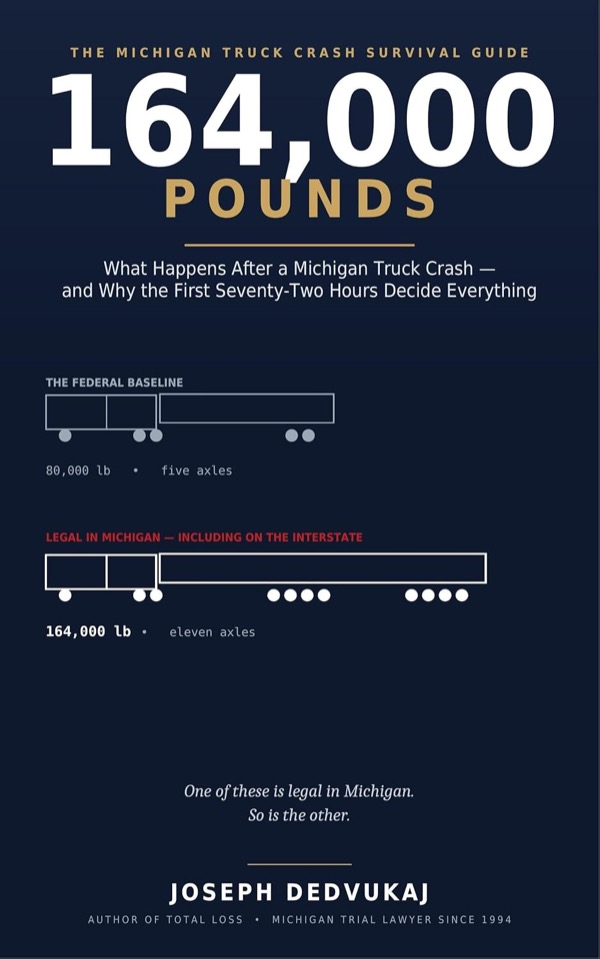
The 72-Hour Truck Crash Protocol — developed by Michigan trial lawyer and author Joseph Dedvukaj. Read the full Protocol and explore 164,000 Pounds.
The framework prioritizes the following as facts and access permit. An urgent task starts when it is identified, not when its window opens.
| Window | Priority |
|---|---|
| 0–6 hours | Locate the truck and every likely evidence custodian. Identify what is at immediate risk. Send preservation demands to the carrier, its insurer and the tow yard. |
| 6–24 hours | Identify the electronic systems on the truck, the camera owners near the scene, the relevant records and the required backups. Follow up on every demand. |
| 24–48 hours | Schedule inspections and data retrieval with qualified examiners. Investigate ownership, leasing, broker and shipper relationships, and insurance. |
| 48–72 hours | Confirm what has actually been preserved. Document the gaps. Decide whether early filing is needed to reach nonparty evidence. |
Preservation continues past 72 hours. If days or weeks have already passed, relevant evidence may still exist. The next step is finding out what remains.
Call 866-HIRE-JOE to discuss your Michigan truck crash, or read about our Michigan truck-accident representation.
Attorney advertising. General educational information, not legal advice. Reading this article or contacting the firm does not by itself create an attorney-client relationship. Rules and deadlines depend on the facts. Evidence-retention periods are separate from the deadlines to give notice, apply for benefits or file a lawsuit. No attorney fee or costs if no recovery.