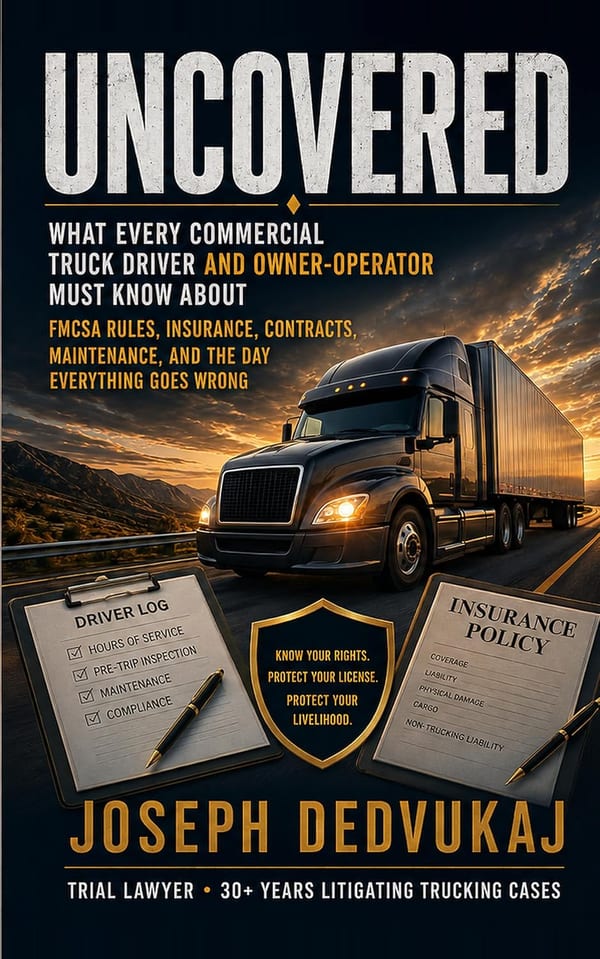
UNCOVERED
What Every Commercial Truck Driver and Owner-Operator Must Know About FMCSA Rules, Insurance, Contracts, Maintenance, and the Day Everything Goes Wrong
by Joseph Dedvukaj · Square Lake Press · 2026
The paperwork you signed is not what you think it says.
One clause in your operating agreement can decide who pays when something goes wrong. One exclusion or definition in an insurance policy can determine whether there is coverage when you need it most. And somewhere in a carrier’s file may be a document that will one day be printed, enlarged, and shown to a jury — with your name on it.
Nobody hands a commercial truck driver or owner-operator the manual for any of this.
UNCOVERED is that manual.
Trial lawyer Joseph Dedvukaj has spent more than thirty years litigating serious injury and trucking cases — reading the operating agreements, pulling the maintenance records, and asking why nobody examined a brake assembly before it went in a dumpster. In plain English, he explains the federal rules, contracts, coverages, and business decisions that determine whether a driver keeps his license, his truck, his income, and the business he spent years building.
Inside
- How the law decides whether you are an employee, an independent contractor, or something in between — regardless of what the contract calls you, and why carriers quietly insure against the risk that they got it wrong
- How lease-purchase arrangements actually work, and why the federal Truck Leasing Task Force unanimously recommended that Congress ban carrier lease-purchase agreements
- The Truth-in-Leasing rules that can give owner-operators rights to chargeback documentation, rated freight bills, insurance-cost information, and escrow accountings
- What primary liability, non-trucking liability, bobtail, physical damage, cargo, occupational accident, workers’ compensation, and contingent liability coverage actually do — and why the policy language decides it
- Hours of service, ELD records, the Drug and Alcohol Clearinghouse, roadside inspections, out-of-service orders, CSA, PSP, and how to challenge bad data through DataQs
- The eighteen-month audition: the federal new-entrant safety audit that fails carriers on paperwork rather than driving, where a single violation ends it
- Why maintenance invoices, brake records, inspection reports, telematics, and ELD data become evidence whether you want them to or not
- What to photograph, what to preserve, whom to notify, and why releasing or repairing a truck too quickly can destroy a case before anyone realizes it mattered
- What a serious injury or a death means for benefits, third-party claims, life insurance, business continuity, and the family left behind
Thirteen appendices
A contract red-flag checklist, an insurance coverage audit, a post-crash preservation checklist, a fifty-state verification worksheet, and a federal record-retention quick reference, among others.
Federal regulatory material in this edition was checked against authoritative sources through August 2026, and the governing regulations are identified throughout so you can verify the important rules yourself before relying on anyone’s interpretation — including the author’s.
Written for the driver, not the carrier
You do not need to become a lawyer. You need to know which questions can end a career, cost you a business, or change your family’s future — and ask them before somebody else does.
Where UNCOVERED looks at trucking from inside the cab, 164,000 POUNDS looks at it from the other side of the crash — what an injured family faces, and why the first seventy-two hours decide what can ever be proved.
Joseph Dedvukaj has represented injured people throughout Michigan for more than three decades in motor vehicle and trucking cases, and is the author of several books on Michigan injury law published by Square Lake Press. See all titles →
Injured in a Michigan crash? Learn how our firm handles these cases, or call (248) 352-2110.
General educational information, not legal advice. Reading it does not create an attorney-client relationship. Consult a qualified professional about your situation.