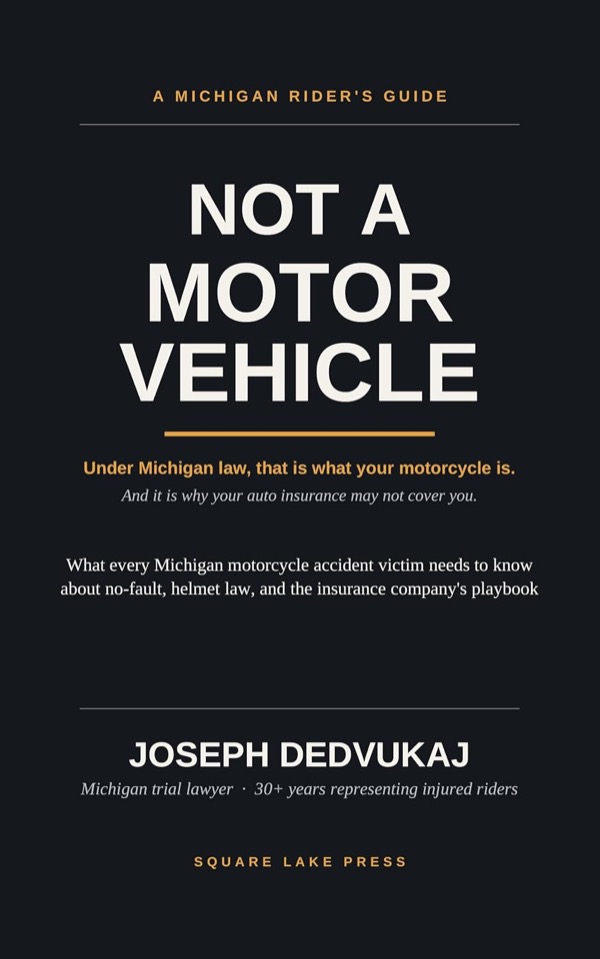
NOT A MOTOR VEHICLE
What Every Michigan Motorcycle Accident Victim Needs to Know About No-Fault, Helmets, and the Insurance Company's Playbook
by Joseph Dedvukaj · Square Lake Press · 2026
Under Michigan's no-fault law, your motorcycle is not a “motor vehicle.”
That one definition can change almost everything about an injury claim. It sounds like a technicality. It isn’t.
When a motorcyclist is injured in a crash involving a car or truck, the rules governing medical benefits can be very different from the rules that apply to someone injured inside a car. The insurance that pays first may belong to someone else. The amount of medical coverage available may depend on coverage choices the rider never made. And when one policy’s benefits run out, knowing where Michigan law says to look next can make an enormous difference.
Most riders discover these rules only after the crash. This book was written so you can understand them before an insurance company uses them against you.
Michigan personal-injury attorney Joseph Dedvukaj draws on more than three decades of experience representing injured people and explains Michigan motorcycle-accident law in clear, practical language.
Inside, you’ll learn
- Why a motorcycle is excluded from the definition of “motor vehicle” under Michigan’s no-fault law — and why that distinction matters after a crash
- Which insurance company may be responsible for a motorcyclist’s no-fault benefits, and the statutory order that determines who pays
- What happens when the first available PIP policy has limited medical coverage or becomes exhausted
- How Michigan’s 2019 no-fault reforms changed the risks facing motorcycle riders
- When a motorcycle-only crash may leave a rider without traditional no-fault PIP benefits
- What Michigan law really says about riding without a helmet — and what helmet use does, and does not, mean for an injury claim
- The deadlines that can destroy otherwise valid claims
- What to do immediately after a crash — including recorded statements, insurer-requested medical examinations, photographs, witnesses, and preservation of the motorcycle itself
- How insurance companies investigate speed, visibility, braking, lane position, and rider conduct
- How fault, comparative negligence, medical evidence, insurance coverage, and damages come together in a serious motorcycle case
Riders are judged before the evidence is in
Motorcycle cases carry assumptions that ordinary automobile cases often do not. Riders are frequently judged before the evidence is fully developed. Speed is assumed. Risk-taking is assumed. Fault is assumed.
Those assumptions can be challenged — but only if the evidence is preserved and the claim is handled correctly from the beginning.
NOT A MOTOR VEHICLE explains what happens from the moment of impact through the insurance claim, investigation, medical treatment, negotiations, litigation, and, when necessary, trial.
No law-school lecture. No unnecessary jargon. Just a practical explanation of what Michigan riders and their families need to know when the stakes are highest — because after a motorcycle crash, understanding the rules may be almost as important as understanding what happened. See all titles →
Injured in a Michigan crash? Learn how our firm handles these cases, or call (248) 352-2110.
General information about Michigan law, current as of publication. This book is not legal advice and does not create an attorney-client relationship. Laws and court decisions can change. Anyone injured in a motorcycle crash should obtain advice concerning the specific facts of his or her case.