



You slipped on an unmarked wet floor at a grocery store, fell hard on your back, and now you’re facing weeks of physical therapy and mounting medical bills. Or perhaps you tripped on a broken sidewalk outside a business, fracturing your wrist and missing work for months. As you navigate the physical pain and financial stress, one question dominates your thoughts: “What is my slip and fall case worth?” You’ve heard settlement amounts ranging from a few thousand dollars to hundreds of thousands, but you have no idea what to expect for your specific situation.
Understanding slip and fall settlement amounts helps you evaluate settlement offers, avoid accepting inadequate compensation, and know when to fight for more. While every case is unique and no attorney can guarantee specific outcomes, certain patterns emerge in premises liability claims. This guide will explain typical settlement ranges, factors that increase or decrease value, how surgery affects compensation, and strategies for maximizing your Michigan slip and fall claim.
Typical Settlement Ranges for Slip and Fall Cases
Slip and fall settlements vary dramatically based on injury severity, liability clarity, and other factors. However, general ranges provide context:
Minor Injuries (Soft Tissue, Bruising, Minor Sprains):
- Settlement Range: $5,000-$15,000
- Characteristics: Brief medical treatment, full recovery within weeks, minimal lost wages
- Examples: Bruising, minor sprains, strains requiring only conservative treatment
Moderate Injuries (Significant Sprains, Simple Fractures):
- Settlement Range: $15,000-$50,000
- Characteristics: Extended treatment, physical therapy, several weeks of lost work, no surgery
- Examples: Ankle sprains requiring months of therapy, minor fractures healing with casting
Significant Injuries (Fractures Requiring Surgery, Herniated Discs):
- Settlement Range: $50,000-$150,000
- Characteristics: Surgery, months of recovery, significant lost wages, permanent impairment possible
- Examples: Broken bones requiring surgical repair, herniated discs with radiculopathy
Severe Injuries (Multiple Fractures, Spinal Injuries, Traumatic Brain Injuries):
- Settlement Range: $150,000-$500,000+
- Characteristics: Multiple surgeries, permanent disability, extensive lost earning capacity, ongoing medical needs
- Examples: Spinal cord injuries, severe traumatic brain injuries, multiple complex fractures
Catastrophic Injuries (Paralysis, Severe Permanent Disability):
- Settlement Range: $500,000-$5,000,000+
- Characteristics: Permanent total or partial disability, lifetime medical care needs, complete life alteration
- Examples: Paralysis from spinal cord injury, severe brain damage, amputations
These ranges are generalizations. Your specific case may fall outside these ranges based on numerous factors discussed below.
Factors Affecting Slip and Fall Settlement Value

Several key factors work together to determine your slip and fall settlement value. Understanding each component helps you build the strongest possible case:
Injury Severity: More severe injuries warrant substantially higher compensation. Courts and insurance companies consider the type of injury (fractures command more than soft tissue injuries), the number of injuries sustained, whether surgery was required, the permanence of any impairment, and how profoundly injuries impact daily activities and quality of life.
Medical Expenses: Higher medical bills generally correlate with higher settlements. Thorough documentation of all expenses is essential:
- Emergency room visits and hospitalization costs
- Surgery expenses and anesthesia fees
- Doctor appointments and specialist consultations
- Physical therapy and rehabilitation sessions
- Prescription medications
- Medical equipment (crutches, wheelchairs, braces)
- Projected future medical care costs
Lost Wages: Compensation captures multiple dimensions of income loss:
- Past lost income from missed work during recovery
- Future lost earning capacity when injuries prevent returning to previous employment
- Lost benefits and bonuses that would have been earned
- For the self-employed, lost business opportunities that cannot be recovered
Pain and Suffering: Non-economic damages account for the human toll of your injuries—physical pain and discomfort, emotional distress and mental anguish, loss of enjoyment when activities that once brought joy become impossible, permanent disability and disfigurement that alter identity, and devastating impacts on relationships and daily activities.
Liability Clarity: The clearer the property owner’s fault, the higher the settlement. Strong cases have:
- Obvious hazardous conditions (large holes, broken stairs, hidden ice)
- Evidence the owner knew or should have known about the hazard
- Violation of building codes or safety regulations
- Lack of warnings about dangerous conditions
- Documentation through photos, videos, or witness statements
Comparative Negligence: Michigan’s comparative fault rule reduces recovery if you share blame. If you’re found 30% at fault (perhaps for not watching where you walked), your settlement decreases by 30%. If you’re more than 50% at fault, you recover nothing.
Property Owner’s Insurance: Available insurance coverage limits your practical recovery. Even if damages justify $500,000, if the property owner only carries $100,000 in liability coverage and has no significant personal assets, recovery may be limited.
Attorney Quality: Experienced premises liability lawyers secure higher settlements than general practitioners or unrepresented claimants because they:
- Accurately value claims
- Build thorough cases with strong evidence
- Negotiate aggressively
- Have trial experience that encourages fair settlement offers
Jurisdiction and Venue: Some Michigan counties tend toward higher verdicts than others. Cases in Wayne County (Detroit) often see different outcomes than cases in rural counties.
Pre-Existing Conditions: Prior injuries or conditions affecting the same body part reduce settlements. However, if the fall significantly worsened pre-existing conditions, you can still recover for the aggravation.
At The Joseph Dedvukaj Firm, we’ve handled hundreds of slip and fall cases, from minor injuries to catastrophic falls causing permanent disability. Our experience allows accurate case valuation and aggressive pursuit of maximum compensation.
Slip and Fall Settlements Without Surgery vs. With Surgery
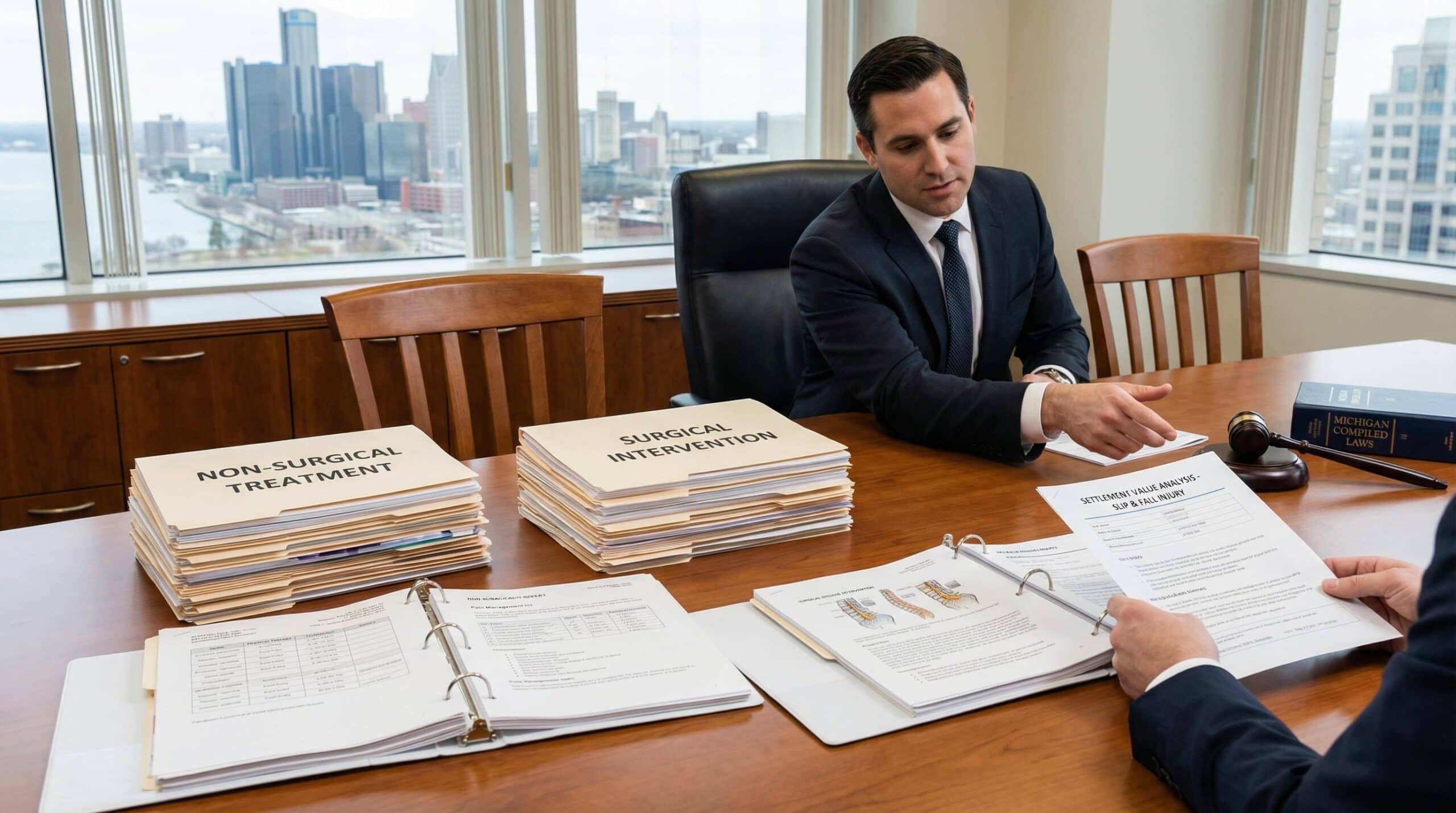
Surgery significantly affects slip and fall settlement amounts because it indicates:
- Injury severity requiring invasive intervention
- Higher medical costs
- Extended recovery time and lost wages
- Greater pain and suffering
- Increased likelihood of permanent impairment
Without Surgery:
Soft Tissue Injuries (Sprains, Strains, Contusions):
- Average Settlement: $5,000-$25,000
- Treatment: Conservative care (rest, ice, physical therapy, medications)
- Recovery: Weeks to months
- Challenges: Insurance companies often minimize soft tissue injuries as minor, temporary, or pre-existing
- Maximizing Value: Consistent medical treatment, thorough documentation of symptoms, compliance with treatment plans, expert medical testimony
Fractures Healing with Casting:
- Average Settlement: $20,000-$60,000
- Treatment: Casting or bracing, physical therapy
- Recovery: Months
- Factors: Fracture location and severity, whether healing complications occurred, residual function loss
Herniated Discs Without Surgery:
- Average Settlement: $40,000-$120,000
- Treatment: Injections, physical therapy, pain management
- Recovery: Variable—some improve significantly, others have ongoing pain
- Factors: Degree of herniation, nerve involvement, radiculopathy symptoms, impact on function
With Surgery:
Fractures Requiring Surgical Repair:
- Average Settlement: $75,000-$250,000
- Surgeries: ORIF (open reduction internal fixation), pinning, joint replacement
- Factors: Number of fractures, surgical complications, hardware permanence, residual limitations
- Examples: Hip fractures, complex ankle fractures, wrist fractures requiring plates/screws
Spinal Surgeries (Discectomy, Fusion):
- Average Settlement: $150,000-$500,000+
- Surgeries: Microdiscectomy, laminectomy, spinal fusion
- Factors: Single vs. multi-level fusion, success of surgery, permanence of limitations, future surgery needs
- Impact: Spinal surgeries often result in permanent restrictions on lifting, bending, and physical activities
Traumatic Brain Injury Requiring Surgery:
- Average Settlement: $300,000-$3,000,000+
- Surgeries: Craniotomy, hematoma evacuation, skull repair
- Factors: Severity of cognitive impairment, personality changes, ability to return to work, lifetime care needs
Multiple Surgeries:
Cases requiring multiple surgical procedures—such as a fall causing both spinal and orthopedic injuries—typically settle for significantly higher amounts, often $250,000-$1,000,000+ depending on severity and permanence.
Why Surgery Increases Value:
- Objective proof of injury severity
- Higher medical expenses
- Extended recovery and lost wages
- Greater pain and suffering (surgery itself is painful and traumatic)
- Permanent hardware, scars, or impairments
- Increased risk of future complications
Even with surgery, building maximum value requires:
- Complete medical documentation
- Expert testimony on necessity of surgery and prognosis
- Life care planning for future medical needs
- Economic experts calculating lost earning capacity
- Thorough presentation of pain and suffering impacts
Proving Property Owner Negligence in Slip and Fall Cases
Premises liability claims require proving the property owner’s negligence caused your injuries. Michigan law requires establishing:
1. The Property Owner Owed You a Duty of Care:
Invitees (customers, business visitors): Property owners owe the highest duty—to maintain reasonably safe premises and warn of known hazards
Licensees (social guests): Property owners must warn of known dangers
Trespassers: Property owners owe minimal duty except to avoid willful/wanton harm
2. A Hazardous Condition Existed:
Common hazards in slip and fall cases include:
- Wet floors without warning signs
- Uneven or broken flooring
- Torn carpeting or mats
- Poorly maintained stairs
- Inadequate lighting
- Ice and snow on walkways
- Spilled liquids or debris
- Hidden elevation changes
- Broken handrails
3. The Owner Knew or Should Have Known About the Hazard:
Actual knowledge: The owner created the hazard or was informed about it
Constructive knowledge: The hazard existed long enough that reasonable inspection would have discovered it
Mode of operation: In certain businesses (grocery stores, restaurants), courts may find liability when hazards are foreseeable based on the business’s normal operations
4. The Owner Failed to Fix the Hazard or Warn About It:
Property owners must either:
- Eliminate the hazard within a reasonable time
- Provide adequate warnings (wet floor signs, barricades, lighting)
5. The Hazard Caused Your Injuries:
You must prove the fall resulted from the hazardous condition and caused your specific injuries. Medical records, expert testimony, and accident scene documentation establish causation.
Evidence Critical for Slip and Fall Cases:
- Photographs/videos of the hazard and accident scene
- Incident reports filed with the property owner
- Witness statements from people who saw the fall or the hazard
- Surveillance footage from the property
- Maintenance records showing when the area was last inspected or cleaned
- Medical records documenting injuries immediately after the fall
- Your account of exactly what happened
- Expert testimony on building codes, industry standards, or accident reconstruction
The sooner you contact a premises liability lawyer, the better chance of preserving critical evidence before it disappears.
Michigan’s Comparative Negligence Rule in Slip and Fall Cases
Michigan follows modified comparative negligence (MCL 600.2959), which significantly affects slip and fall settlements:
How It Works:
- Fault is allocated among all parties as percentages
- Your recovery is reduced by your percentage of fault
- If you’re 51% or more at fault, you recover nothing
Common Defense Arguments:
Property owners and their insurers commonly argue you contributed to the accident by:
- Failing to watch where you were walking (distracted by phone, conversation, etc.)
- Wearing inappropriate footwear for conditions (high heels on ice)
- Ignoring obvious hazards (walking around barriers or warning signs)
- Being in restricted areas where you weren’t authorized
- Being intoxicated or otherwise impaired
Countering Comparative Negligence:
Strong cases overcome these defenses by showing:
- The hazard was not obvious (hidden, poor lighting, no warnings)
- You were exercising reasonable care for the circumstances
- The property owner’s negligence was the primary cause of the fall
- Any inattention on your part was minor compared to the owner’s failure
Example:
You slip on clear ice in a poorly lit parking lot with no salt or warnings. Insurance argues you should have seen the ice and walked more carefully, claiming you’re 40% at fault. Your attorney counters that the property owner violated duty to maintain safe premises and provide adequate lighting. The case settles with you found 20% at fault.
- Total damages: $100,000
- Your fault: 20%
- Settlement: $80,000
This is why experienced slip and fall attorneys are crucial—they anticipate and counter comparative negligence arguments before they reduce your recovery.
Maximizing Your Premises Liability Settlement
To secure the highest possible slip and fall settlement:
Immediate Actions:
Report the Fall: File an incident report with the property owner immediately, even if injuries seem minor initially. Get a copy.
Document Everything: Photograph the hazard, your injuries, and the surrounding area. If others witnessed the fall, get their contact information.
Seek Medical Attention: See a doctor immediately, even for seemingly minor injuries. Delayed treatment gives insurance companies ammunition to argue injuries aren’t serious or aren’t related to the fall.
Preserve Evidence: Keep the clothes and shoes you wore during the fall (they may show evidence of the hazard). Don’t return to the scene and assume the hazard is still there—property owners often fix hazards immediately after accidents.
Don’t Give Statements: Property owners or insurers may contact you seeking recorded statements. Politely decline and refer them to your attorney.
Throughout Your Case:
Follow Treatment Plans: Attend all medical appointments, complete prescribed physical therapy, and follow doctor recommendations. Gaps in treatment suggest injuries aren’t serious.
Document Impact: Keep a journal detailing pain levels, limitations, missed activities, and how injuries affect daily life. This strengthens pain and suffering claims.
Avoid Social Media: Insurance companies monitor social media for evidence contradicting injury claims. A photo of you smiling at an event can be twisted to suggest you’re not really suffering.
Be Patient: Don’t accept quick settlement offers before understanding the full extent of injuries and future medical needs. Once you settle and sign a release, you cannot pursue additional compensation if injuries worsen.
Hire Experienced Legal Representation: The single most important factor in maximizing settlements is having a skilled premises liability attorney who knows how to build and present these cases effectively.
The Joseph Dedvukaj Firm has secured substantial settlements for Michigan slip and fall victims, including cases where insurance companies initially offered minimal compensation or denied claims entirely. Our thorough case preparation, expert witness network, and trial readiness encourage insurance companies to settle fairly.
Get Help from Experienced Michigan Personal Injury Lawyers

Slip and fall injuries can be devastating—physically, emotionally, and financially. You deserve fair compensation that addresses all your damages, not a quick lowball settlement that leaves you struggling with ongoing medical bills and lost income.
Understanding typical slip and fall settlement amounts helps you evaluate offers, but every case is unique. The factors discussed above—injury severity, surgery needs, liability clarity, comparative negligence, and attorney quality—combine in complex ways to determine your specific case’s value.
Don’t navigate this alone. The Joseph Dedvukaj Firm has served injured Michigan residents since 1994, recovering over $300 million in settlements, judgments, and verdicts. Our premises liability experience includes substantial recoveries for clients who suffered serious injuries in slip and fall accidents.
Attorney Joseph Dedvukaj holds an AV Preeminent Peer Review Rating from Martindale-Hubbell—the highest possible rating for legal ability and ethical standards. His membership in the National Trial Lawyers: Top 100 reflects peer recognition of exceptional trial skills. When insurance companies know we’re prepared to try cases when necessary, they settle more reasonably.
When you choose The Joseph Dedvukaj Firm for your slip and fall case, you receive:
- Accurate valuation based on 30+ years of experience
- Thorough investigation to preserve critical evidence
- Expert witnesses to establish liability and damages
- Aggressive negotiation with insurance companies
- Trial readiness that encourages fair settlements
- No upfront costs—we work on contingency and advance all case expenses
- Personal attention from experienced attorneys, not just paralegals
Don’t accept inadequate settlement offers or let property owners escape responsibility for their negligence. Contact The Joseph Dedvukaj Firm today for a free, no-obligation consultation. We’ll review your case, explain what it’s worth, and outline a clear strategy for maximum recovery.
Time is critical—Michigan’s statute of limitations generally gives you three years to file premises liability lawsuits, but evidence disappears quickly. Surveillance footage gets deleted, hazards get fixed, and witnesses forget details. The sooner you have experienced legal representation, the stronger your case becomes.
Call 1-866-HIRE-JOE or visit our website to schedule your free consultation. We serve clients throughout Michigan from our Bloomfield Hills office and are ready to fight for the compensation you deserve.
You’ve suffered enough. Let us handle the legal battle while you focus on healing and rebuilding your life. Learn more about our experience with personal injury cases throughout Michigan.