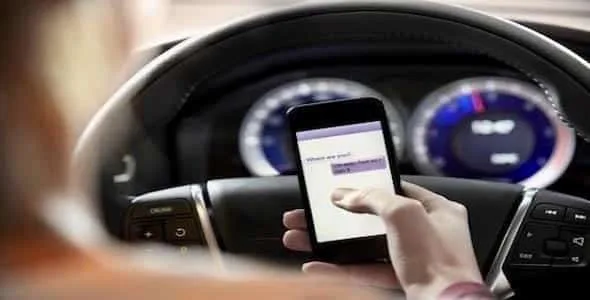
Distracted driving has become one of the leading causes of car accidents in Michigan. Since June 30, 2023, Michigan law has prohibited the hand-held use of cell phones while driving, making it illegal to text, make calls, watch videos, or use social media without a hands-free device. But even with stronger laws on the books, distracted driving crashes continue to cause devastating injuries across the state. If you were hit by a driver who was on their phone or otherwise not paying attention, proving distracted driving is the key to holding them accountable.
Michigan’s Distracted Driving Laws
Under MCL 257.602b, Michigan drivers are prohibited from using a hand-held cell phone or mobile electronic device while operating a motor vehicle. The law covers talking on the phone, texting, recording or watching videos, scrolling social media, and using apps, unless the device is used in a hands-free mode such as voice commands or Bluetooth.
Violations carry escalating penalties. A first offense results in a $100 fine or 16 hours of community service. A second offense increases to $250 or 24 hours of community service. For drivers with a Graduated Driver License (under 18), cell phone use while driving is completely prohibited, even hands-free, under Kelsey’s Law.
If a driver violates this law and causes an accident, the violation itself serves as strong evidence of negligence. However, distracted driving is not limited to cell phone use. Eating, adjusting a GPS, reaching for items, grooming, and even daydreaming all qualify as distractions that can impair a driver’s ability to safely operate a vehicle.
Types of Evidence Used to Prove Distracted Driving
Building a successful distracted driving claim requires assembling multiple types of evidence that collectively tell a convincing story. No single piece of evidence is usually enough on its own, but together they can create a compelling case. Here are the primary sources of proof.
Cell phone records. An attorney can subpoena the at-fault driver’s cell phone records from their wireless carrier. These records show exactly when calls were made, texts were sent, and data sessions occurred. If the records show a text message sent at 3:42 p.m. and the accident happened at 3:42 p.m., that is powerful evidence of distraction. Carrier records typically include call logs with start and end times, SMS and MMS timestamps, and data usage session logs.
Phone device data. Beyond carrier records, the phone itself may contain valuable evidence. App activity logs can show when navigation, social media, streaming, or messaging apps were actively being used. GPS data stored on the phone can reveal the driver’s speed and location at the time of the crash. This type of forensic data extraction often requires a specialist but can provide extremely detailed evidence.
Witness testimony. Eyewitnesses who saw the other driver looking down at their phone, swerving, or otherwise appearing distracted before the crash can provide compelling testimony. Passengers in the at-fault driver’s vehicle may also be willing to testify about the driver’s behavior. Even the 911 caller’s report can contain useful observations about what they saw immediately before the collision.
Surveillance and Electronic Evidence
Modern technology provides several additional sources of evidence that did not exist a generation ago. Knowing where to look for this evidence, and acting quickly to preserve it, can make the difference between a successful claim and one that falls short.
Traffic and surveillance cameras. Intersection cameras, business security cameras, and residential doorbell cameras may have captured footage of the accident or the moments leading up to it. This footage can show whether the at-fault driver was looking down, drifting out of their lane, or failing to brake before the collision. Time is critical because many surveillance systems overwrite footage within days or weeks.
Event data recorders (EDRs). Most modern vehicles are equipped with EDRs, sometimes called “black boxes,” that record data about the vehicle’s operation in the seconds before a crash. EDR data can show vehicle speed, braking input, steering angle, throttle position, and whether seatbelts were engaged. If the data shows the at-fault driver never braked before the collision, it supports the argument that they were not watching the road.
Dashcam and body camera footage. If you, another driver, or a nearby police officer had a dashcam or body camera running, the footage may have captured the other driver’s behavior. Some commercial vehicles and rideshare vehicles are also equipped with interior and exterior cameras that may provide relevant evidence.
The Police Report and Accident Reconstruction
The police report is often the first piece of evidence examined in a distracted driving claim. When responding officers arrive at the scene, they document their observations, take statements from drivers and witnesses, note road conditions, and sometimes issue citations. If the officer noted that the at-fault driver admitted to using their phone or appeared distracted, that observation carries significant weight.
In more complex cases, an accident reconstruction expert may be retained to analyze the physical evidence and determine how the crash occurred. Reconstruction experts examine skid marks (or the absence of skid marks), vehicle damage patterns, the point of impact, and debris fields. By applying principles of physics and engineering, they can calculate each vehicle’s speed and trajectory and determine whether the at-fault driver’s actions were consistent with inattention.
For example, if a driver rear-ended you at full speed with no evidence of braking on a straight road with clear visibility, an accident reconstruction expert can testify that this pattern is consistent with a driver who was not looking at the road, which is a hallmark of distracted driving.
Why Acting Quickly Matters
Evidence of distracted driving can disappear quickly if steps are not taken to preserve it. Cell phone carriers routinely purge records after a set period. Surveillance footage is overwritten on short cycles. Phones are reset, replaced, or updated. Witnesses move away or forget details. Vehicle EDR data can be lost if the vehicle is repaired or scrapped.
An experienced personal injury attorney can send preservation letters (also called spoliation letters) to the other driver, their insurance company, nearby businesses, and wireless carriers, demanding that they retain any evidence related to the crash. If evidence is destroyed after a preservation letter has been sent, the responsible party may face serious legal consequences, including adverse inference instructions at trial.
The statute of limitations for filing a personal injury lawsuit in Michigan is generally three years from the date of the accident. However, waiting that long to begin building your case is a mistake. The sooner evidence is preserved and an investigation begins, the stronger your claim will be.
Distracted Driving and Michigan’s Serious Impairment Threshold
Michigan’s no-fault system requires that your injuries meet the serious impairment of body function threshold before you can pursue a third-party negligence claim for pain and suffering. Proving that the other driver was distracted does not change this threshold, but it significantly strengthens your case on the question of fault once the threshold is met.
If the at-fault driver was violating Michigan’s distracted driving law at the time of the crash, you also have a strong argument for negligence per se, a legal doctrine that establishes a driver’s negligence based on the violation of a statute designed to protect public safety. This can simplify the liability portion of your case and allow your attorney to focus on proving the full extent of your damages.
Damages in a distracted driving auto accident case may include compensation for pain and suffering, emotional distress, loss of quality of life, scarring and disfigurement, and loss of consortium. In cases involving particularly egregious behavior, such as watching videos or livestreaming while driving, there may be grounds for enhanced damages.
Contact a Michigan Distracted Driving Accident Attorney
If you or a loved one has been injured by a distracted driver in Michigan, you deserve an attorney who knows how to find and preserve the evidence needed to prove your case. At The Joseph Dedvukaj Firm, we have the resources and experience to investigate distracted driving accidents thoroughly, from subpoenaing cell phone records to retaining accident reconstruction experts.
We handle auto accident, trucking accident, and wrongful death cases throughout Michigan. Contact us today for a free consultation, or call 866-HIRE-JOE to speak with an attorney who will fight to hold the distracted driver accountable for the harm they caused.