
Your family celebrated your daughter’s birthday at a popular restaurant. Within hours, everyone became violently ill with vomiting, diarrhea, and fever. Your youngest child required hospitalization for severe dehydration.
Health department testing confirmed Salmonella contamination, and you learned the restaurant had recent health code violations for improper food storage and preparation. As medical bills pile up and you miss work caring for sick family members, you wonder: Can you sue for food poisoning? When are restaurants liable for foodborne illness?
What evidence is needed to prove the restaurant caused your illness? What compensation can you recover for medical expenses, lost wages, and the pain and suffering your family endured?
Food poisoning from contaminated food affects millions of Americans annually, causing serious illness, hospitalization, and sometimes death. When restaurants, food manufacturers, or retailers negligently handle, prepare, or serve contaminated food, they can be held legally liable through product liability, negligence, and breach of warranty claims. Understanding when food poisoning creates legal liability, how to prove restaurant responsibility, common foodborne illnesses and their dangers, gathering critical evidence, and damages available helps victims pursue compensation for serious illness caused by others’ failures to maintain food safety.
When You Can Sue for Food Poisoning
Not every case of food poisoning creates legal liability, but when restaurants or food service establishments negligently cause serious illness, multiple legal theories provide paths to compensation.
Strict product liability treats contaminated food as a defective product. Under this theory, restaurants and manufacturers who sell adulterated, dangerous food are responsible regardless of fault. You don’t need to prove negligence, only that the food was contaminated with pathogens, the contamination made the food unreasonably dangerous, it reached you in that contaminated condition, and it caused your illness.
This powerful legal doctrine recognizes that consumers have no way to detect contamination and should be protected from dangerous food products.
Negligence claims focus on failures to exercise reasonable care in food handling and preparation. Restaurants breach their duty of care through improper food storage at dangerous temperatures, cross-contamination during preparation when raw and cooked foods contact each other, inadequate cooking temperatures that fail to kill bacteria, poor employee hygiene including sick workers handling food, failure to follow health codes, and generally unsanitary conditions. Proving negligence requires demonstrating that these specific failures caused your illness.
Breach of implied warranty provides another avenue for recovery. When restaurants sell food, they implicitly warrant that it’s fit for consumption. Contaminated food that causes illness breaches this warranty of merchantability.
Customers are entitled to receive safe, wholesome food, and when food fails to meet this basic standard, warranty claims arise.
Common liability scenarios include undercooked meat harboring dangerous bacteria, contaminated produce that wasn’t properly washed, food left at temperatures in the “danger zone” where bacteria multiply rapidly, sick employees who handle food and spread pathogens, rodent or pest contamination, and cross-contamination when raw foods contact ready-to-eat items. Each scenario reflects failures in basic food safety protocols that professional food service establishments should maintain without exception.
However, successful claims require establishing a clear causal connection between the restaurant’s food and your illness. Cases become difficult or impossible when you can’t definitively prove you ate at the defendant’s restaurant, can’t establish their food rather than other sources caused your illness, your symptoms don’t match the timing or expected pathogen, no other customers reported similar illness from the same restaurant or food batch, or health department inspections find no violations. You must prove that the specific restaurant’s specific food caused your specific illness.
That is a challenging but achievable standard when proper evidence is gathered.
At The Joseph Dedvukaj Firm, we help food poisoning victims meticulously gather medical records, laboratory results, receipts, and witness statements that establish liability and pursue compensation for serious foodborne illnesses requiring hospitalization or causing lasting health effects.
Common Foodborne Illnesses and Their Dangers
Various pathogens cause food poisoning, each with distinct characteristics, timelines, and dangers. Understanding which pathogen caused your illness helps establish the timeline connecting restaurant food to your symptoms. This is crucial evidence in liability claims.
| Pathogen | Common Sources | Onset | Key Symptoms | Serious Dangers |
|---|---|---|---|---|
| Salmonella | Undercooked poultry, eggs, produce | 6 hours-6 days | Diarrhea, fever, cramps | Severe dehydration, bloodstream infection (1.35M annual U.S. cases) |
| E. coli O157:H7 | Undercooked beef, contaminated produce | 3-4 days | Bloody diarrhea, severe cramps | Hemolytic uremic syndrome (kidney failure), especially dangerous for children |
| Listeria | Deli meats, soft cheeses, unpasteurized products | 1-4 weeks | Fever, muscle aches, nausea | Meningitis, septicemia, miscarriage, 20-30% fatality rate |
| Campylobacter | Undercooked poultry, unpasteurized milk | 2-5 days | Bloody diarrhea, fever | Guillain-Barré syndrome (paralysis), arthritis |
| Norovirus | Food handled by infected workers | 12-48 hours | Vomiting, diarrhea | Severe dehydration, highly contagious |
| Hepatitis A | Contaminated food/water, infected handlers | 15-50 days | Fatigue, jaundice | Liver failure (vaccine-preventable) |
The severity of foodborne illness determines both your medical outcome and legal claim value. While many cases resolve with rest and fluids at home, certain symptoms demand immediate hospitalization. Seek emergency medical care for severe dehydration that causes dizziness, rapid heartbeat, or decreased urination, bloody diarrhea indicating serious intestinal damage, high fever over 102°F suggesting systemic infection, prolonged vomiting that prevents keeping fluids down and leads to dangerous dehydration, or any signs of neurological problems including confusion, weakness, or tingling.
Pregnant women, elderly patients, young children, and immunocompromised individuals face higher risks and should seek medical attention earlier than healthy adults would.
Hospitalization dramatically increases damages in legal claims, providing clear documentation of illness severity that insurance companies cannot easily dismiss, medical expenses that quickly reach thousands of dollars creating substantial economic damages, and objective evidence that your food poisoning exceeded the “normal” range of foodborne illness that resolves on its own. When children require IV fluids, when elderly patients develop septic infections, when previously healthy adults experience organ damage, these cases demonstrate the serious harm that negligent food handling causes and justify substantial compensation.
Proving Restaurant Caused Your Food Poisoning
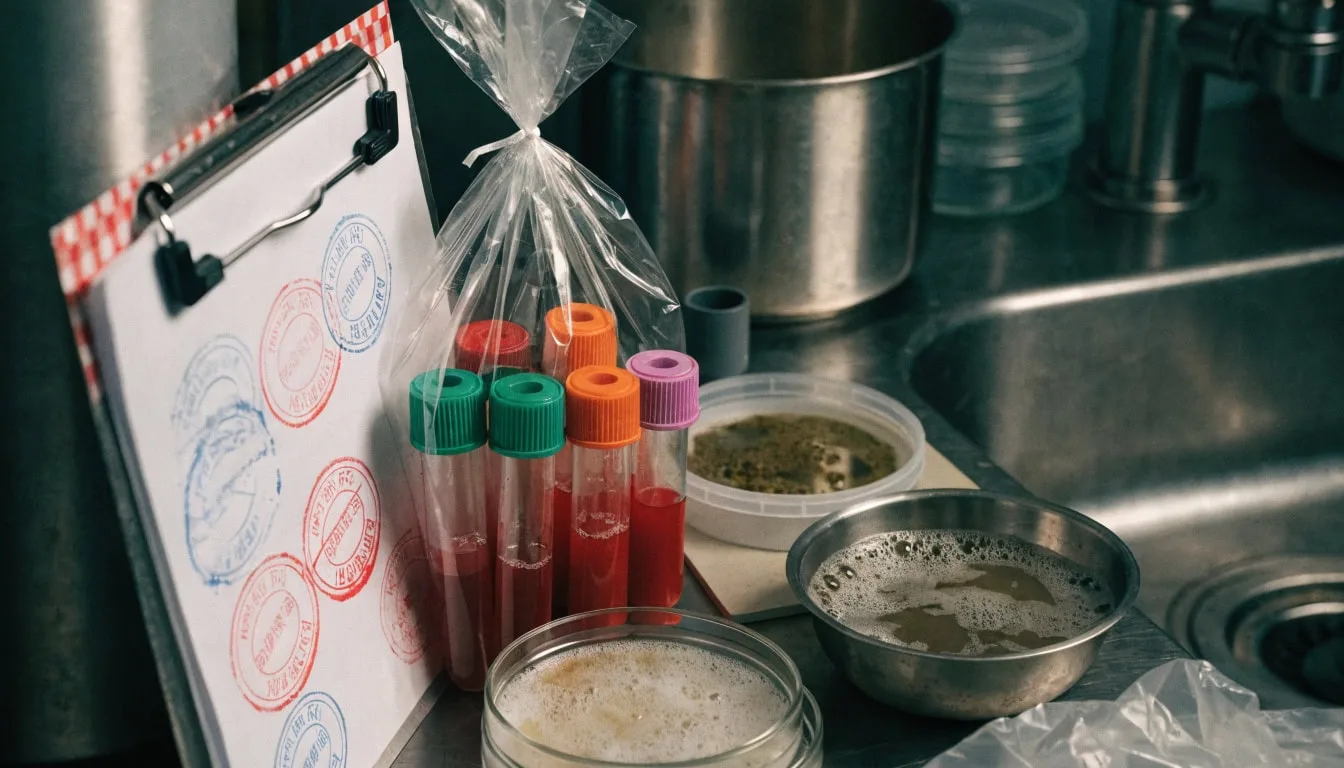
Successful food poisoning claims depend on strong evidence establishing a clear connection between the restaurant’s food and your illness. Time-sensitive documentation makes the difference between cases that settle for substantial compensation and claims that collapse under scrutiny.
Medical documentation forms the foundation of every food poisoning claim. Seeking medical treatment immediately creates records documenting your symptoms, their severity, and their onset timing in ways that prove illness rather than exaggeration. Stool sample testing identifies the specific pathogen causing your illness, whether Salmonella, E.
coli, Campylobacter, or another bacteria, providing scientific proof rather than speculation. Blood tests detect severe infections that have spread beyond the intestinal tract into the bloodstream, demonstrating the serious nature of your illness. Medical records document every symptom you experienced, when it started, how long it lasted, and how severely it affected you.
Hospitalization records prove your illness was serious enough to require emergency medical intervention with IV fluids, antibiotics, and continuous monitoring. Without medical documentation, proving both the existence and severity of your food poisoning becomes nearly impossible, turning your claim into a “he said, she said” dispute that insurance companies easily defeat.
Pathogen identification is critical to proving causation. You must prove not just that you became ill, but that a specific bacteria or virus caused your illness and that the bacteria came from the restaurant’s food. Laboratory testing of your stool sample provides definitive identification of the pathogen, allowing experts to explain that the specific bacteria has known incubation periods, characteristic symptoms, and typical sources that all align with eating at the defendant’s restaurant on the date in question.
Timeline documentation establishes the crucial connection between your restaurant visit and your subsequent illness. Your restaurant receipt provides proof of when and where you ate, creating a fixed point in time from which the incubation period can be calculated. Credit card statements confirm the restaurant visit independently of your recollection, providing objective third-party verification.
Witness statements from others who ate with you and became ill strengthen the pattern of illness stemming from that specific meal. Most importantly, documenting when your symptoms began and comparing that timing to the known incubation period for the identified pathogen creates powerful circumstantial evidence. For example, if you ate at a restaurant Sunday evening and symptoms began Tuesday morning, 36 hours later, and stool testing shows Salmonella with a typical incubation period of 6 hours to 6 days, the timeline is consistent with Salmonella from the restaurant food eaten Sunday.
Health department reports provide critical independent evidence of restaurant violations and contamination. Inspection reports showing recent violations at the restaurant demonstrate a pattern of unsafe food handling practices that made contamination foreseeable and preventable. Outbreak investigations conducted when multiple people reported illness from the same restaurant create official government findings about the contamination source.
Laboratory testing of food samples collected from the restaurant can show the same pathogen that caused your illness, directly linking the restaurant’s food to your infection. Closure orders issued when the health department shut down the restaurant demonstrate that violations were severe enough to pose an immediate threat to public health. These public records are often available through Freedom of Information Act requests and provide evidence from neutral government agencies rather than interested parties.
Evidence that other victims became ill from the same restaurant dramatically strengthens your case by showing a pattern rather than an isolated incident. Multiple reports from different people who ate at the restaurant and became ill suggest widespread contamination rather than individual misfortune. When testing confirms the same pathogen caused illness in multiple victims, coincidence becomes implausible and restaurant liability becomes obvious.
If multiple victims became ill after eating the same food item, that points directly to the specific contaminated dish served. CDC or local health department outbreak investigations documenting widespread illness create official findings that establish liability clearly. When many people were sickened by the same source, class action lawsuits become possible, allowing victims to combine their claims for more efficient litigation and potentially larger total recoveries.
If you still have leftover food or packaging from the meal that made you sick, preserve it immediately. Refrigerate or freeze remaining food to prevent further bacterial growth while preserving current contamination levels for testing. Don’t discard packaging, wrappers, or containers that may contain identifying information about food sources, lot numbers, and preparation dates.
Photograph food and containers before storing them, creating visual documentation of exactly what you consumed. Laboratory testing of preserved food samples may directly identify contamination, proving beyond doubt that the restaurant’s food contained the pathogen that caused your illness. That is the most powerful evidence possible.
Expert testimony from infectious disease specialists and food safety experts provides crucial professional opinions that juries respect and insurance companies cannot easily dismiss. These experts testify about incubation periods for specific pathogens, confirming that the timeline between your restaurant visit and symptom onset is consistent with infection from that meal. They explain pathogen characteristics and typical sources, demonstrating that the bacteria found in your system commonly comes from the type of food the restaurant served.
Food safety experts identify violations of industry standards in the restaurant’s food handling, storage, and preparation practices. Most importantly, medical experts provide causation testimony linking the restaurant’s food to your illness with reasonable medical certainty, the legal standard required to hold restaurants liable.
Gathering Evidence for Food Poisoning Claims
Taking immediate action after food poisoning preserves critical evidence and protects your legal rights. Time-sensitive steps make the difference between strong claims backed by documentation and weak cases that collapse under scrutiny.
Seek medical treatment immediately, not just for your health, but because proper diagnosis and treatment create medical records documenting your illness. Request stool sample testing to identify the specific pathogen causing your symptoms, as many emergency departments won’t automatically order these tests unless you specifically ask. Allow blood tests to detect severe infections spreading beyond the intestinal tract.
Ensure every symptom you experience is documented in medical records, describing severity accurately rather than downplaying discomfort. If your symptoms are severe enough to warrant hospitalization, admission to the hospital provides the strongest possible documentation that your illness required emergency medical intervention. Without medical documentation from licensed providers, proving the severity of your food poisoning becomes nearly impossible.
Insurance companies will claim you exaggerated symptoms or that the illness was minor and temporary.
If you have leftover food or packaging from the meal, preserve it carefully before contamination degrades or evidence disappears. Refrigerate or freeze remaining food in sealed containers, preventing bacterial growth from continuing while maintaining current contamination for potential laboratory testing. Save all containers and packaging with identifying information including restaurant names, food descriptions, and any lot numbers or dates.
Photograph everything before storage, capturing visual evidence of exactly what you consumed and its condition when symptoms began. Resist the natural temptation to throw away potential evidence in disgust or to clean your refrigerator. Laboratory testing of food samples can directly prove contamination, creating irrefutable evidence linking the restaurant’s specific food to your specific illness.
That evidence is so powerful that many cases settle immediately once testing confirms the link.
Document everything connected to your illness with meticulous attention to detail that creates a comprehensive evidentiary record. Keep restaurant receipts proving when and where you ate, as these receipts provide dated, third-party documentation of your restaurant visit that you cannot fabricate after the fact. Preserve credit card statements confirming the restaurant charge, creating independent financial records that verify your receipt.
Collect all medical bills and records from every provider who treated your illness, as these documents prove both the existence and severity of your condition through licensed professionals’ observations. Take photos of visible symptoms if you develop rashes, jaundice, or other physical manifestations of your illness. Most importantly, maintain a detailed journal tracking symptoms and their severity day by day, documenting how the illness progressed, what treatments you tried, how the illness affected your daily activities, and how long recovery took.
This contemporaneous documentation is far more credible than trying to recall details months later during litigation.
Report your illness to the local health department as soon as you have medical confirmation of food poisoning. Your complaint triggers an inspection of the restaurant that may uncover current violations, unsafe food handling practices, or other problems. It creates an official government record of the incident that exists independently of your legal claim.
Your report helps health officials identify outbreaks affecting multiple people, as your complaint may be one of many revealing a pattern of contamination. Finally, reporting protects other diners from the same dangerous food, potentially preventing additional illnesses while the restaurant continues serving contaminated food. Health department inspection reports triggered by your complaint become powerful evidence in legal claims, particularly when inspections reveal violations that explain how contamination occurred.
Identify and preserve contact information for potential witnesses who can corroborate your account. Get names and phone numbers of others who ate with you and became ill, as multiple victims proving the same pattern of illness from the same meal eliminates coincidence as an explanation. Collect information from other patrons who ate at the restaurant around the same time, as they may have become ill or observed unsanitary conditions.
Preserve contact information for anyone who can confirm your restaurant visit, countering any suggestion that you ate elsewhere. Document statements from people who observed unsanitary conditions at the restaurant, including friends who noticed problems during your meal together. Multiple victims strengthen claims dramatically, often leading to class action lawsuits or mass tort proceedings where numerous victims combine their claims for more efficient litigation.
If you observed problems at the restaurant during your visit, document them immediately through photographs or video before memory fades and evidence disappears. Photograph dirty dining areas, food debris on floors or tables, or other sanitation issues. Document visible evidence of rodents or pests, including droppings, insects, or the pests themselves.
Capture images of improper food storage such as food left at room temperature that should be refrigerated, raw meats stored above ready-to-eat foods, or uncovered food exposed to contamination. Photograph any visible health code violations posted by authorities or obvious safety problems. Even social media posts from your visit may contain photos or comments useful to your case.
Seemingly innocent photos of your meal may show undercooked meat or other problems you didn’t notice at the time.
Consult an attorney specializing in food poisoning cases before talking to the restaurant or their insurance company. Restaurants and their insurers will contact you quickly, seeking statements and trying to pressure you into quick settlements that grossly undervalue your claim before you understand its full value. Early legal advice ensures you preserve evidence properly using methods that maintain evidentiary value for litigation, avoid making statements that insurance companies will use against you during settlement negotiations or trial, understand the full value of your claim before accepting any settlement offers, and protect your rights from the moment illness occurs rather than after critical evidence has been destroyed or time has run out.
Attorneys experienced in food poisoning cases understand what evidence is needed, which experts to consult, and how to prove restaurant liability even when establishments deny responsibility.
Damages Available in Food Poisoning Cases
Compensation in food poisoning cases depends primarily on illness severity, with damages ranging from thousands of dollars for cases requiring brief hospitalization to millions in cases involving permanent injury or death.
Economic damages compensate for all financial losses caused by food poisoning. Medical expenses form the largest category in severe cases, encompassing emergency room visits that quickly cost thousands of dollars, hospitalization charges that accumulate daily for room fees plus intensive treatment, diagnostic testing including stool samples, blood tests, imaging studies, and specialized laboratory analysis, medications ranging from antibiotics to anti-nausea drugs to pain management, follow-up care with gastroenterologists and infectious disease specialists, and treatment for long-term complications when initial infection causes lasting health problems. Lost wages extend beyond your own time off work during acute illness to include weeks or months of reduced earning capacity during recovery, wages lost while caring for sick family members who cannot care for themselves, and potentially permanent reductions in earning capacity if complications prevent you from returning to your previous occupation.
Out-of-pocket costs include travel expenses for medical treatment, over-the-counter medications and supplies for symptom management, and household help needed during recovery when you cannot perform normal activities like cooking, cleaning, and child care.
Non-economic damages compensate for physical and emotional suffering that cannot be precisely calculated but deserves substantial compensation nonetheless. Pain and suffering encompasses the severe physical pain and discomfort of acute food poisoning including violent vomiting, painful diarrhea, debilitating cramps, and fever, multiplied by the duration of suffering that may last weeks or months. The severity and duration of symptoms directly affects pain and suffering values.
Hospitalization for a week of agony justifies far more compensation than two days of discomfort at home. Fear and anxiety about your health, your family’s health, and potential complications adds to suffering. Even the embarrassment from uncontrollable symptoms that rob you of dignity during illness deserves recognition in compensation.
Permanent injuries from severe food poisoning dramatically increase claim values into six or seven figures. Guillain-Barré syndrome develops in some Campylobacter cases, causing progressive paralysis that may require months of rehabilitation and can leave permanent weakness or disability. Hemolytic uremic syndrome from E.
coli O157:H7 causes kidney damage requiring dialysis, potentially for life, with some victims needing kidney transplants. Reactive arthritis triggered by various pathogens causes chronic joint pain and swelling that persists for months or years, limiting physical activity and reducing quality of life. Irritable bowel syndrome develops in some victims after severe food poisoning, creating chronic digestive issues, pain, and dietary restrictions that last indefinitely.
Post-infectious fatigue can persist for months, leaving previously active people exhausted and unable to maintain normal activity levels. When these permanent complications prevent you from working, enjoying activities, or living independently, lifetime economic losses and pain and suffering values reach into the millions.
Wrongful death damages apply when food poisoning proves fatal, as it can in vulnerable populations including the elderly, infants, and immunocompromised individuals. Families can recover funeral and burial expenses for the immediate costs of laying their loved one to rest, loss of financial support that the deceased would have provided over their expected lifetime, loss of companionship and guidance that family members suffer when a parent, spouse, or child dies, and compensation for the decedent’s pain and suffering before death if they experienced prolonged agony before succumbing to infection. When Listeria causes septicemia in an elderly nursing home resident, when E.
coli causes kidney failure in a young child, when Salmonella proves fatal to a cancer patient with weakened immunity, these wrongful death cases recognize that food poisoning is not always a minor illness but can be deadly serious.
Typical settlement ranges in food poisoning cases vary dramatically based on severity:
| Severity Level | Typical Settlement Range |
|---|---|
| Mild illness, no hospitalization | $5,000-$20,000 |
| Hospitalization required | $20,000-$100,000 |
| Severe complications | $100,000-$500,000 |
| Permanent injury or death | $500,000-$5,000,000+ |
Outbreak cases involving many victims may result in class actions or mass tort proceedings that settle for millions of dollars divided among victims based on their individual severity. Major foodborne illness outbreaks linked to national restaurant chains or food manufacturers have produced total settlements exceeding tens of millions of dollars when hundreds or thousands of people became ill from widespread contamination.
Multiple factors affect individual case value beyond just medical bills. The length of hospitalization directly correlates with settlement value, as each day in the hospital demonstrates serious illness requiring intensive medical intervention. Permanent complications multiply values dramatically compared to full recovery cases.
Lost wages and future earning capacity losses add substantial economic damages for victims whose illness prevents them from working. The number of victims affects values, with outbreak cases often settling for more per victim due to clear proof of restaurant fault and public relations pressure on defendants. The severity of the restaurant’s negligence matters.
Willful violations creating obvious contamination risks justify higher compensation than isolated accidents. Finally, available insurance coverage limits potential recovery regardless of actual damages, making it essential to identify all possible insurance sources including general liability policies, umbrella policies, and food contamination-specific coverage.
Get Help from Experienced Michigan Personal Injury Lawyers
Food poisoning cases require quick action to preserve evidence and prove causation. While many cases seem straightforward, establishing that the specific restaurant served the specific contaminated food that caused your specific illness requires strategic investigation and strong evidence that typical personal injury practices may not provide.
The Joseph Dedvukaj Firm handles food poisoning cases throughout Michigan, working with medical experts, infectious disease specialists, and food safety consultants to prove liability and maximize compensation.
Our experience with foodborne illness claims means we understand the unique evidentiary challenges these cases present and how to overcome insurance company defenses that exploit the difficulties of proving causation in food contamination cases.
Attorney Joseph Dedvukaj’s AV Preeminent rating from Martindale-Hubbell represents the highest possible rating for legal ability and ethical standards, awarded by fellow attorneys and members of the judiciary who recognize exceptional skill. His National Trial Lawyers: Top 100 membership reflects selection by peers as among the best trial lawyers in the nation. Our firm’s track record includes over $350 million recovered for Michigan injury victims across all case types, with substantial settlements in food poisoning cases requiring hospitalization or causing lasting complications.
When you choose The Joseph Dedvukaj Firm for your food poisoning case, you receive immediate evidence preservation guidance to ensure critical medical testing, food samples, and documentation are obtained before evidence disappears. We coordinate with health department investigations to obtain official inspection reports and outbreak data. We consult with medical experts who can definitively establish causation linking your illness to the restaurant’s food.
We develop comprehensive proof demonstrating that the restaurant’s food caused your illness through timelines, laboratory testing, and expert testimony. We document all damages thoroughly including medical expenses, lost wages, and pain and suffering to ensure complete compensation. You pay no upfront costs.
We work on a contingency fee basis where our fees come only from settlements or verdicts we secure for you.
If you or a family member suffered serious food poisoning requiring hospitalization or causing lasting complications like kidney damage, paralysis, or chronic digestive problems, contact The Joseph Dedvukaj Firm today for a free consultation with no obligation. Call 1-866-HIRE-JOE or visit our website. We serve Michigan food poisoning victims from our Bloomfield Hills office, representing clients throughout the state.
Time is critical in food poisoning cases. Evidence deteriorates quickly as symptoms resolve and people discard food, and Michigan’s three-year statute of limitations from the date of illness creates absolute deadlines for filing lawsuits. Early consultation ensures proper evidence preservation through immediate medical testing and documentation, expert analysis of causation while facts are fresh, and protection of your legal rights from the moment illness occurs.
Your serious illness deserves accountability from restaurants that failed to maintain basic food safety standards. Let experienced attorneys fight for the compensation you deserve while you focus on recovery and rebuilding your health. For cases involving fatal foodborne illness, learn more about our wrongful death practice and how we help families pursue justice when negligence causes death.