


You were operating your commercial vehicle exactly as trained when another driver ran a red light, causing a devastating collision. Now, beyond dealing with your injuries, you’re worried about your CDL (Commercial Driver’s License)—your livelihood depends on it. The accident is under investigation, and you’ve heard that accidents can affect your CDL status, insurance rates, and employment. You wonder: What happens to my CDL after an accident? Can I lose my license even if the accident wasn’t my fault? What are the requirements for maintaining commercial driving privileges in Michigan, and how do accidents impact my career?
CDL holders face higher standards than regular drivers. The Federal Motor Carrier Safety Administration (FMCSA) and Michigan impose strict requirements on commercial drivers, and accidents—even those not your fault—can have serious consequences for your driving record, employability, and insurance costs. Understanding Michigan’s CDL requirements, how accidents affect commercial driving privileges, what violations can end your career, and when to seek legal help is essential for protecting your livelihood after accidents.
What Is a CDL and Who Needs One in Michigan?
A Commercial Driver’s License (CDL) is required to operate large or heavy vehicles, vehicles transporting hazardous materials, or vehicles designed to carry multiple passengers.
Vehicles Requiring CDLs:
Class A CDL authorizes combination vehicles with Gross Combination Weight Rating (GCWR) of 26,001 pounds or more, provided the towed vehicle weighs 10,001 pounds or more. This classification covers semi-trucks with trailers hauling freight across the country, tractor-trailers in various configurations, tanker trucks with trailers transporting liquids or gases, and livestock carriers moving animals long distances.
Class B CDL permits single vehicles with Gross Vehicle Weight Rating (GVWR) of 26,001 pounds or more, or vehicles towing trailers under 10,001 pounds. Common Class B vehicles include straight trucks delivering goods locally, large buses transporting passengers within cities or on tours, dump trucks hauling construction materials, and delivery trucks making commercial stops.
Class C CDL applies to vehicles designed to transport 16 or more passengers including the driver, or vehicles carrying hazardous materials requiring placarding regardless of vehicle size. This covers small buses for shuttle services, passenger vans for hotels or group transport, and HazMat vehicles carrying quantities of dangerous materials requiring warning placards.
CDL Endorsements:
Additional endorsements authorize specific vehicle types or cargo beyond basic CDL classes. H endorsement permits hazardous materials transport requiring special handling. N endorsement authorizes tank vehicles carrying liquids or gases. P endorsement allows passenger transport in buses. S endorsement specifically authorizes school bus operation with children. T endorsement permits double and triple trailer combinations. X endorsement combines tank vehicle and hazardous materials authorizations for the most specialized operations.
Why CDLs Matter:
Commercial drivers are held to higher standards than regular drivers because larger vehicles cause more severe accidents when collisions occur, with mass and momentum creating catastrophic damage. Professional drivers should demonstrate superior skills given their occupation depends on safe vehicle operation. Public safety critically depends on qualified commercial operators who understand vehicle limitations and safe operating practices. Finally, employers need assurance that drivers meet rigorous federal standards protecting companies from liability when properly trained drivers operate commercial fleets.
At The Joseph Dedvukaj Firm, we understand the unique challenges CDL holders face after accidents and how accidents can affect commercial driving careers spanning decades.
Michigan CDL Requirements and Qualifications

Obtaining and maintaining Michigan CDLs requires meeting federal and state standards that exceed requirements for regular driver’s licenses.
Age Requirements:
Commercial driving age requirements depend on operating scope. 18-year-olds may obtain CDLs for intrastate commercial driving within Michigan only, allowing younger drivers to begin careers while restricted to state boundaries. 21-year-olds can engage in interstate commerce crossing state lines and transport hazardous materials, recognizing that long-haul driving and dangerous cargo transport require additional maturity and experience.
Basic Qualifications:
Prospective CDL holders must hold valid regular driver’s licenses demonstrating basic driving competence before advancing to commercial privileges. They must pass written knowledge tests covering CDL class-specific information and any endorsements sought, ensuring theoretical understanding before practical training. Skills tests including pre-trip inspections, basic vehicle controls, and on-road driving demonstrate practical ability to operate commercial vehicles safely. Medical certification requirements ensure physical capability to handle demanding commercial driving. Background checks screen for disqualifying criminal histories. Finally, maintaining relatively clean driving records compared to commercial standards shows responsible driving habits worthy of professional privileges.
Medical Certification:
Commercial drivers must pass DOT physical examinations administered by certified medical examiners who understand commercial driving demands. Certifications require renewal every two years, or more frequently when medical conditions require closer monitoring. Drivers must meet strict vision, hearing, blood pressure, and general health standards exceeding regular license requirements. Full disclosure of medical conditions that could impair safe driving is mandatory, with falsification grounds for license revocation.
Disqualifying medical conditions that prevent CDL eligibility include insulin-dependent diabetes without specific federal waivers demonstrating safe management, epilepsy or seizure disorders creating sudden loss of control risks, serious cardiovascular conditions like recent heart attacks or uncontrolled hypertension, severe respiratory conditions limiting oxygen to the brain, and alcohol or drug dependency preventing safe operation judgment.
Training Requirements:
Entry-Level Driver Training (ELDT) became federally mandated in February 2022, requiring completion of theory and behind-the-wheel training from FMCSA-registered providers meeting federal curriculum standards. Training must be specific to the CDL class and endorsements sought rather than generic instruction. Documentation in the FMCSA Training Provider Registry creates permanent records verifying proper training completion before licensing.
Continuing Requirements:
Driver Qualification Files that employers must maintain include employment applications with complete work history, driving records from previous employers showing accident and violation history, annual motor vehicle record checks updating driving records, current medical certifications proving continued fitness, road test certificates from employer verification or third-party testing, and comprehensive drug and alcohol testing records documenting compliance with substance abuse programs.
Hours of Service Compliance mandates strict rules limiting driving hours and requiring minimum rest periods, preventing fatigue-related accidents through federally mandated schedules.
Drug and Alcohol Testing programs include random testing throughout employment, mandatory post-accident testing after crashes meeting federal thresholds, reasonable suspicion testing when supervisors observe impairment signs, and return-to-duty testing after violations before drivers can resume safety-sensitive functions.
Maintaining CDLs requires ongoing compliance with all regulations—violations can result in suspensions temporarily removing driving privileges, revocations permanently ending licenses, or disqualifications barring commercial driving for specified periods.
How Accidents Affect CDL Status and Employment
Commercial driver accidents have more severe consequences than accidents involving regular licenses, affecting both licensing and employment.
Accident Reporting Requirements:
CDL holders must report all traffic violations except parking citations to employers within 30 days, regardless of what vehicle type they were driving when violations occurred. This comprehensive reporting includes accidents in personal vehicles during off-duty hours, any traffic tickets from any jurisdiction, and license suspensions or revocations from any state. Employer notification must occur immediately for accidents occurring while on duty, ensuring employers can investigate and respond appropriately to incidents involving their equipment and cargo.
CDL Disqualification Periods:
| Violation Type | Examples | Disqualification Period |
|---|---|---|
| Serious Traffic Violations | Speeding 15+ mph over limit, reckless driving, improper lane changes, following too closely, violations involving fatalities, driving CMV without CDL/proper endorsement | 60 days (2 violations in 3 years) 120 days (3 violations in 3 years) |
| Major Violations (1st offense) | Driving CMV under influence, refusing chemical testing, leaving accident scenes, using CMV to commit felonies, driving with suspended/revoked license | 1 year (3 years if transporting hazmat) |
| Major Violations (2nd offense) | Second occurrence of above violations | Lifetime (may be reducible to 10 years) |
At-Fault Determinations:
Even if accidents weren’t your fault legally under state negligence law, they still appear permanently on driving records that employers review during hiring. Accidents affect insurance rates for employers who must pay higher premiums for drivers with accident histories regardless of fault. They influence employer hiring decisions when multiple equally qualified applicants compete for positions. Finally, accidents create difficult questions during background checks that require explanations potentially raising concerns.
Insurance Consequences:
Commercial driver accidents cause increased insurance premiums for employers whose rates rise with each claim filed. Some employers face possible termination of drivers when their insurance carriers won’t continue coverage due to accident frequency or severity. Drivers with accident histories experience difficulty finding new employment when prospective employers review driving records and see multiple incidents suggesting higher risk.
Employment Impact:
Many trucking companies maintain strict accident policies that dramatically limit employment options. No-accident requirements within specific timeframes, often three years, automatically disqualify applicants with recent crashes regardless of fault or circumstances. Automatic termination for preventable accidents follows company determinations that drivers could have avoided collisions through different actions. Progressive discipline for multiple accidents creates escalating consequences where second or third accidents result in termination. Finally, widespread refusal to hire drivers with recent accident histories limits job opportunities when industry standards create uniform employment barriers.
Losing your CDL or employability can devastate careers spanning decades and destroy financial security built through years of professional driving.
Proving Driver Negligence in Truck Accident Cases
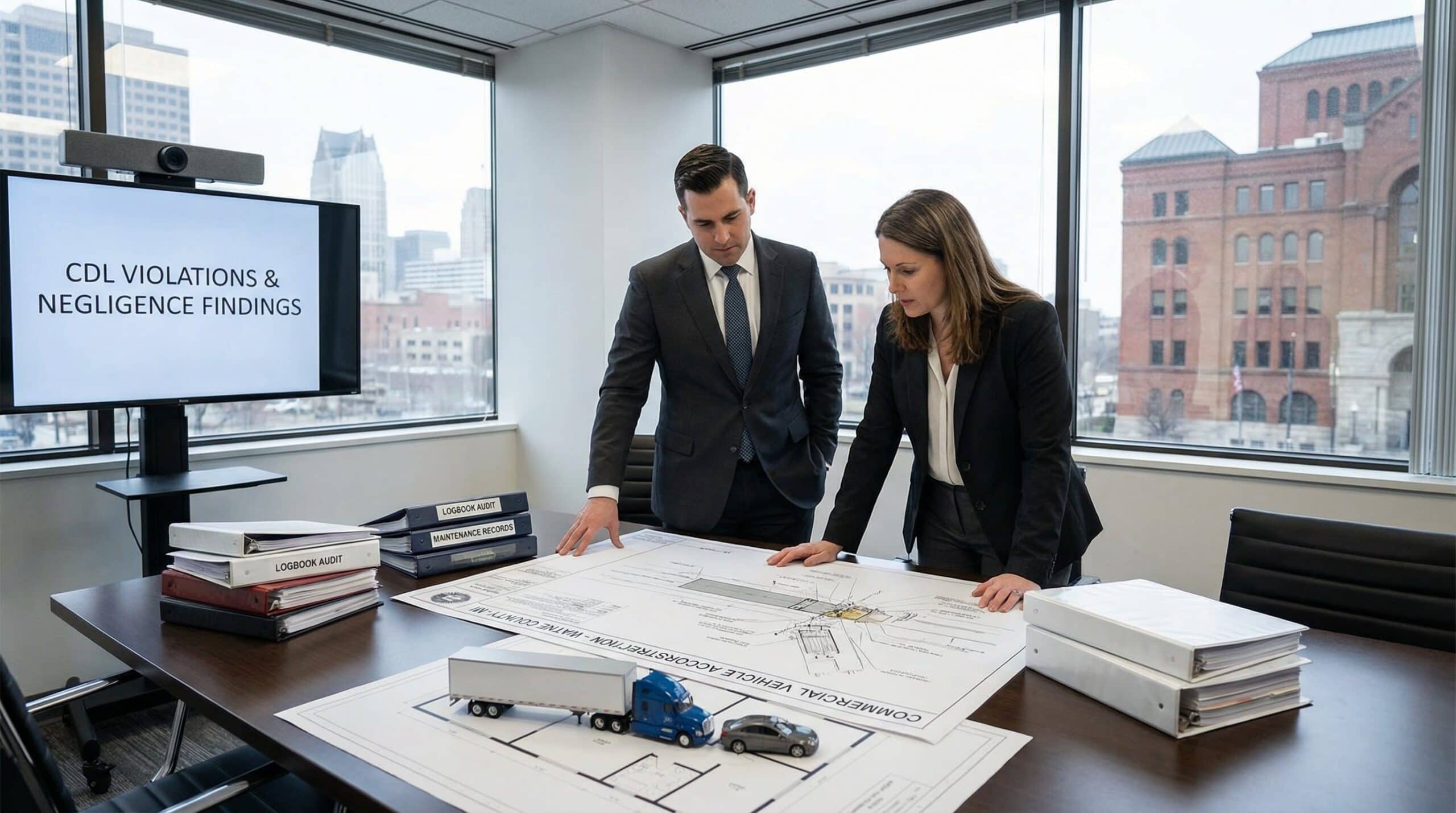
When truck accidents occur, establishing fault involves investigating whether drivers violated CDL requirements or safety regulations that contributed to collisions.
Hours of Service Violations:
Driver fatigue from exceeding hours-of-service limits represents a major cause of preventable accidents. Evidence proving violations includes Electronic Logging Device (ELD) data creating tamper-resistant records of driving and rest periods, paper logbooks from periods before ELD mandates or when ELDs malfunctioned, employer dispatch records showing delivery schedules requiring illegal driving hours to meet deadlines, and cell phone location data tracking driver movements when logbook accuracy is questioned. Hours of service violations prove negligence per se and establish clear liability when fatigue contributed to accidents.
Improper Licensing:
Drivers operating without proper CDL class or required endorsements demonstrate negligence by undertaking tasks they’re not legally qualified to perform. Common violations include driving Class A combination vehicles with only Class B CDL authorization, transporting hazardous materials requiring placards without H endorsement training, and operating passenger vehicles carrying 16 or more people without P endorsement certification. Each violation establishes that drivers lacked training and qualification for vehicles they operated.
Medical Certification Failures:
Drivers operating commercial vehicles without valid current medical certifications or while having disqualifying medical conditions create liability for themselves and their employers who failed to ensure medical compliance. Expired certifications or undisclosed medical conditions prove regulatory violations supporting negligence claims.
Drug and Alcohol Violations:
Positive drug or alcohol tests provide incontrovertible proof of impairment at legally relevant times. Failed random tests show substance abuse affecting driving ability generally. Post-accident testing revealing impairment establishes negligence directly causing specific crashes, creating clear liability regardless of other accident factors.
Traffic Violations:
Speeding citations, following too closely tickets, improper lane change violations, and other moving violations cited by investigating police provide strong evidence of negligence that juries understand intuitively. Traffic tickets create presumptions of fault that defendants must overcome rather than plaintiffs having to prove wrongdoing.
Inadequate Training:
When employers fail to properly train drivers before assigning commercial vehicles, both drivers and companies face liability for resulting accidents. Evidence includes lack of ELDT completion when training became mandatory in 2022, missing training documentation in driver qualification files during discovery, history of similar violations by the same driver suggesting training deficiencies, and employer’s documented failure to monitor driver performance or provide remedial training after incidents.
Proving Negligence Benefits Accident Victims:
When CDL violations or driver negligence caused accidents, injury victims secure strong liability cases with clear proof of wrongdoing, higher settlement values reflecting defendants’ obvious fault, substantial leverage against insurance companies reluctant to defend indefensible cases, and potential punitive damages when conduct shows reckless disregard for public safety beyond simple negligence.
The Joseph Dedvukaj Firm thoroughly investigates commercial driver qualifications, analyzes ELD data for hours of service violations, and examines regulatory compliance across all federal requirements, using violations as powerful evidence of negligence in truck accident cases.
Protecting Your CDL After an Accident
If you’re a CDL holder involved in an accident, protecting your license and career requires immediate thoughtful action.
Document Everything: Take comprehensive photographs of accident scenes showing vehicle positions, damage, and road conditions. Obtain contact information from all witnesses who saw the collision or relevant events leading to it. Get copies of police reports documenting official determinations and any citations issued. Preserve ELD data and paper logbooks showing your hours of service compliance before accidents. Document weather and traffic conditions explaining environmental factors that contributed to collisions.
Follow Employer Protocols: Notify employers immediately per company policy, recognizing that delayed notification can be grounds for termination regardless of accident fault. Complete accident reports accurately and thoroughly, understanding that reports become permanent company records. Cooperate with internal investigations by answering questions honestly while protecting your rights. Don’t admit fault or make definitive statements about causation without first consulting attorneys who can advise on liability implications.
Obtain Legal Representation: Consider hiring attorneys for multiple specialized purposes. Criminal defense attorneys are essential if you’re facing DUI charges or other serious criminal allegations from accidents. Personal injury attorneys can pursue compensation if you were injured by other drivers’ negligence. Employment lawyers can protect your job if you’re facing termination or disciplinary action. License defense attorneys can fight CDL suspensions or revocations threatening your career.
Seek Immediate Medical Attention: Emergency medical care creates crucial documentation linking injuries directly to accidents through contemporaneous medical records. Proper treatment ensures your injuries are diagnosed and managed appropriately rather than worsening from neglect. Medical documentation supports disability or injury claims if injuries prevent you from continuing commercial driving or require extended recovery periods before returning to work.
Understand Drug and Alcohol Testing: Post-accident testing is mandatory in many circumstances defined by federal regulations. Refusal to submit to required testing results in automatic CDL disqualification as if you tested positive. Positive results end careers without successful completion of Substance Abuse Professional (SAP) programs demonstrating rehabilitation. All testing must follow strict federal protocols, and procedural violations may provide defenses against positive results.
Avoid Admissions: Don’t admit fault or make detailed statements about accident causes beyond required factual reporting to police and employers. Insurance companies for all parties will use any statements against you in settlement negotiations and litigation. Admissions of fault can affect both civil liability and criminal proceedings when charges are filed. Always consult attorneys before giving recorded statements to insurance adjusters or investigators who are trained to elicit damaging admissions.
Review Employment Agreements: Understand your company’s specific accident policies including progressive discipline procedures and termination standards. Know your appeal rights when facing discipline, allowing you to contest unfair determinations. Understand union protections if applicable, as collective bargaining agreements often provide greater protections than employment-at-will standards.
Get Help from Experienced Michigan Personal Injury Lawyers
CDL requirements and commercial driving regulations create unique challenges for truck drivers involved in accidents. Whether you’re a CDL holder injured by another driver or an accident victim injured by a commercial driver, understanding CDL standards and their impact on liability is crucial for protecting rights and maximizing recovery.
The Joseph Dedvukaj Firm has extensive experience with commercial vehicle accidents involving complex regulatory frameworks. We’ve represented both injured CDL holders pursuing personal injury claims against negligent drivers and victims injured by commercial drivers whose violations contributed to crashes. Our thorough understanding of CDL requirements, FMCSA regulations, and commercial driving standards strengthens cases on both sides of the litigation equation.
Attorney Joseph Dedvukaj’s AV Preeminent rating and National Trial Lawyers: Top 100 membership reflect exceptional legal ability recognized by fellow attorneys and the judiciary. Our firm’s track record includes substantial six-figure and seven-figure recoveries in truck accident cases involving catastrophic injuries and clear regulatory violations.
For CDL holders injured in accidents through no fault of their own: We pursue full compensation including economic damages for medical expenses and lost wages, while understanding how injuries affect your commercial driving career and future earning capacity when permanent impairments may prevent returning to professional driving.
For victims of truck accidents: We thoroughly investigate whether driver CDL violations or inadequate qualifications contributed to accidents, using regulatory violations as powerful evidence of negligence establishing clear liability and supporting substantial damage claims.
We work on a contingency fee basis—you pay absolutely nothing upfront and nothing unless we win compensation for you. Contact us for a free consultation at 1-866-HIRE-JOE or visit our website. We serve clients throughout Michigan from our Bloomfield Hills office, representing injured people statewide.
Don’t let accidents destroy your CDL career built over years or decades, or leave you without fair compensation for injuries caused by commercial driver negligence. Let experienced attorneys protect your rights and maximize your recovery while you focus on physical healing and career recovery.