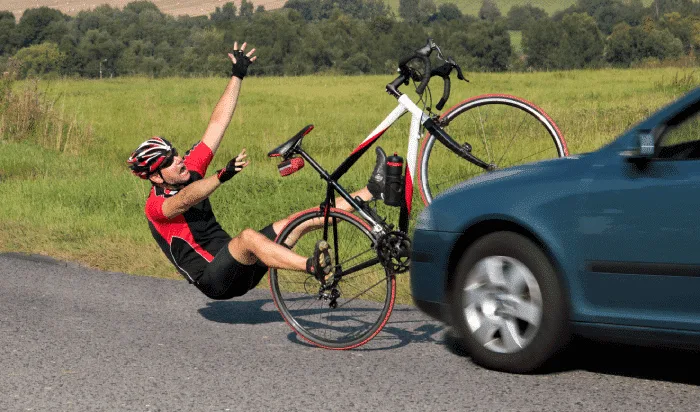
Bicycle accidents involving motor vehicles are among the most serious collisions on Michigan roads. Because cyclists have virtually no physical protection compared to vehicle occupants, these crashes frequently result in catastrophic injuries including traumatic brain injuries, spinal cord damage, broken bones, and internal organ damage. If you have been involved in a bike and car accident in Michigan, understanding how fault is determined is critical to protecting your right to compensation.
Michigan’s legal framework for bicycle-vehicle accidents involves a combination of no-fault insurance rules, comparative negligence principles, and traffic laws that apply to both motorists and cyclists. Navigating these overlapping systems requires experienced legal guidance.
How Michigan Law Determines Fault in Bicycle and Car Accidents
Determining fault in a bike and car accident requires a careful investigation of the circumstances surrounding the collision. Michigan is a modified comparative fault state, meaning that liability is assigned based on each party’s percentage of responsibility for the accident. Multiple parties may share fault, and identifying all responsible parties is essential to maximizing your recovery.
Parties who may bear responsibility for a bicycle-vehicle accident include:
- The motor vehicle driver who may have failed to yield, made an unsafe pass, opened a door into the cyclist’s path (known as “dooring”), ran a red light, or was distracted
- The driver of another vehicle whose actions forced the first vehicle into the cyclist’s path
- The bicyclist who may have run a stop sign, ridden against traffic, failed to use required lights at night, or made an unpredictable maneuver
- A government entity responsible for maintaining safe road conditions, including proper signage, bike lane markings, or road surface repairs
- A manufacturer of a defective bicycle component or vehicle part that contributed to the crash
Police reports, witness statements, traffic camera footage, and physical evidence at the scene all play important roles in establishing fault. An experienced personal injury attorney can conduct a thorough investigation to identify every liable party and gather the evidence needed to support your claim.
Michigan Traffic Laws That Apply to Bicyclists and Motorists
Under Michigan law, bicycles are classified as vehicles, which means cyclists have the same rights and responsibilities as motor vehicle drivers when riding on public roads. Michigan Compiled Laws Section 257.657 establishes that every person riding a bicycle on a roadway has all the rights and is subject to all the duties applicable to the driver of a vehicle.
Key traffic laws relevant to bicycle-car accident fault include:
- Motorists must maintain a minimum distance of five feet when passing a bicyclist (MCL 257.636)
- Bicyclists must ride as far to the right as practicable, with exceptions for left turns, passing, avoiding hazards, and roads too narrow for safe side-by-side travel
- Bicyclists must use a front white light visible from 500 feet and a rear red reflector visible from 600 feet when riding between sunset and sunrise
- Bicyclists must use hand signals when turning or stopping
- Motorists must yield to bicyclists when making right turns across bike lanes
- Both motorists and cyclists must obey all traffic signals and signs
Violations of these traffic laws by either party can serve as strong evidence of negligence. If a driver fails to maintain the required five-foot passing distance and strikes a cyclist, that violation alone can establish liability. Similarly, if a cyclist rides at night without required lighting, this may reduce the cyclist’s percentage of fault recovery.
No-Fault PIP Benefits for Injured Bicyclists in Michigan
One of the most important aspects of Michigan’s legal framework for bicycle accident injuries is the availability of no-fault Personal Injury Protection (PIP) benefits. Under MCL 500.3114, a bicyclist who is injured in a collision with a motor vehicle is entitled to PIP benefits, even if the cyclist does not own a car or carry auto insurance.
PIP benefits for injured cyclists can cover:
- All reasonable and necessary medical expenses related to the accident
- Lost wages at 85% of gross income for up to three years
- Replacement services for household tasks the injured person can no longer perform (up to $20 per day)
- Rehabilitation and occupational therapy costs
The priority order for which insurance company pays PIP benefits to an injured cyclist depends on several factors. If the cyclist has their own auto insurance policy, their insurer pays first. If the cyclist does not have auto insurance but lives with a relative who does, that relative’s insurer is responsible. If neither applies, the insurer of the vehicle involved in the accident covers the PIP claim.
It is critical to note that no-fault PIP benefits only apply when the bicycle accident involves a motor vehicle. If a cyclist crashes due to a road defect, another cyclist, or a pedestrian, PIP benefits are not available, and the injured party must pursue compensation through other legal channels.
Filing a Third-Party Lawsuit After a Bicycle Accident
In addition to no-fault PIP benefits, Michigan law allows injured bicyclists to file a third-party negligence lawsuit against the at-fault driver. To pursue a third-party claim for non-economic damages such as pain and suffering, the cyclist must demonstrate that they suffered a serious impairment of body function, permanent serious disfigurement, or death, as defined by MCL 500.3135.
A third-party lawsuit can provide compensation for:
- Pain and suffering, both past and future
- Emotional distress and mental anguish
- Loss of enjoyment of life
- Permanent disability or disfigurement
- Excess economic damages not covered by PIP, including medical expenses beyond PIP limits and wage loss beyond the three-year PIP period
Given the severity of injuries that typically result from bicycle-vehicle collisions, many cyclists meet the serious impairment threshold. Broken bones requiring surgery, concussions with lasting cognitive effects, road rash requiring skin grafts, and injuries causing permanent scarring often qualify.
What If You Were Partially at Fault for the Bicycle Accident?
Michigan follows a modified comparative fault rule under MCL 600.2959. This means you can still recover damages even if you were partially responsible for the accident, as long as your share of fault does not exceed 50%. However, your compensation will be reduced by your percentage of fault.
For example, if you were found 20% at fault for riding without a headlight at dusk and the driver was 80% at fault for running a stop sign, you would receive 80% of the total damages awarded. If total damages were $200,000, you would recover $160,000.
Insurance companies frequently try to shift blame onto injured cyclists by arguing that the cyclist was not wearing a helmet, was riding outside a bike lane, or failed to make themselves visible. While these factors may be relevant to fault allocation, they do not automatically bar recovery. An experienced attorney can counter these arguments and present evidence that establishes the driver’s primary responsibility for the crash.
Steps to Take After a Bicycle and Car Accident in Michigan
Protecting your legal rights after a bicycle-vehicle accident begins at the scene. Call 911 and request a police report. Seek medical attention immediately, even if your injuries seem minor. Photograph the accident scene, vehicle damage, your bicycle, road conditions, and any visible injuries. Collect contact and insurance information from the driver and any witnesses.
Do not give recorded statements to the driver’s insurance company without consulting an attorney first. Insurance adjusters may attempt to get you to admit partial fault or minimize your injuries. Report the accident to your own auto insurer if you have a policy, as this initiates the PIP benefits process.
Contact a Michigan personal injury lawyer as soon as possible. Michigan’s statute of limitations for personal injury claims is three years from the date of the accident, but early legal involvement ensures critical evidence is preserved and your PIP claim is properly filed.
Get Help After a Michigan Bicycle Accident
Bicycle accident cases involving motor vehicles present unique legal challenges that require knowledge of both Michigan’s no-fault system and traditional negligence law. At The Joseph Dedvukaj Firm, our attorneys have the experience and resources to investigate your accident, identify all liable parties, and pursue maximum compensation for your injuries.
If you were injured in a bike and car accident in Michigan, contact our office for a free consultation. Call 866-HIRE-JOE to speak with an attorney who will evaluate your case and explain your legal options at no cost and no obligation.